
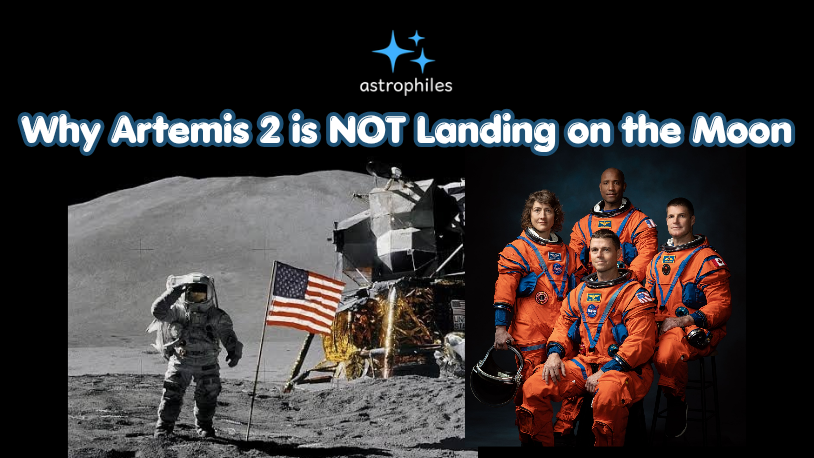
To put it simply, the reason why Artemis 2 is not landing on the Moon is that it is the ultimate “stress test” for human survival in deep space. Before NASA risks putting boots in the lunar dust, this crew must prove that the Orion spacecraft’s life support, navigation, and communication systems can keep humans alive for 10 days in a harsh radiation environment.

When the massive Space Launch System (SLS) rocket finally cleared the launch pad yesterday, the world paid attention. Now that the mission is officially underway, if you are expecting the four astronauts aboard to plant a flag and take a moonwalk, you might be surprised by the actual mission profile.
Understanding exactly why Artemis 2 is not landing on the Moon requires a look at the brutal realities of orbital mechanics and a relentless focus on crew safety. Let’s break down the exact physics behind this historic NASA crewed moon mission.
Quick Facts: The Artemis II Mission Profile
-
Mission Duration: Approximately 10 days
-
Spacecraft: Orion Crew Module
-
Closest Lunar Approach: ~10,300 kilometers (6,400 miles) beyond the far side of the Moon
-
Landing Objective: None (Lunar Flyby Only)
-
Next Surface Landing: Artemis III (Targeted for 2026/2027)
The Big Question: Why Artemis 2 is NOT Landing on the Moon
During our Astrophiles school workshops, especially when we are demonstrating rocket physics with water bottle launches, students always ask the same question: “If we have a rocket big enough to get there, why not just land?”
The answer comes down to incremental testing. The Orion spacecraft flew flawlessly during the uncrewed Artemis I mission, but putting humans inside changes the equation entirely. Humans breathe, sweat, and generate heat. The spacecraft’s Environmental Control and Life Support System (ECLSS) needs to constantly scrub carbon dioxide from the air, regulate temperature, and recycle water.
Before NASA commits to the incredibly complex orbital ballet required to dock with a lunar lander and descend to the surface, they need 100% certainty that the basic “living quarters” function perfectly in the vacuum of space.
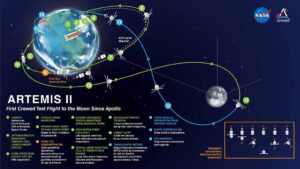
NASA Artemis II Map & Trajectory animation
The “Information Gap”: Why the Free-Return Trajectory is the Ultimate Safety Net
Most news outlets will tell you that the Artemis II flight path goes around the Moon and comes back. But they completely miss why this specific path was chosen. This is where the brilliant physics of the hybrid free-return trajectory comes into play.
When we teach orbital mechanics in our basic astronomy course, I like to use the analogy of a cosmic boomerang.
Instead of firing its engines to enter a circular orbit around the Moon, Orion will deliberately aim slightly off-center. It will fly thousands of miles past the far side of the Moon. By doing this, the Moon’s massive gravitational pull acts like a giant elastic band, grabbing the spacecraft and whipping it right back toward Earth.
The incredible advantage here is safety. Now that Orion has performed its initial burn to leave Earth, it does not need its main engine to get home. Even if the primary propulsion system completely fails in deep space, gravity guarantees the crew will naturally loop back to a safe splashdown in the Pacific Ocean.
Visualizing orbital mechanics can be tricky, but mapping the gravitational “slingshot” reveals the elegance of this mission’s design.
An Apollo 8 Comparison: Echoes of the Past
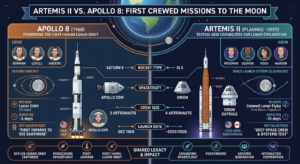
If this flight profile sounds familiar, you might be thinking of the legendary Apollo 8 comparison. In 1968, Apollo 8 became the first crewed spacecraft to leave Earth orbit, travel to the Moon, and return safely without landing.
However, Artemis II is taking a wider path.
While Apollo 8 orbited the Moon closely, Artemis II will fly much further out—over 10,000 kilometers beyond the lunar far side. This means the Artemis II crew will travel deeper into the solar system than any human beings in the history of our species!
While the astronauts are flying further than anyone has before, you don’t need a rocket to track the Moon. With April’s clear skies approaching, check out our guide to the 5 Epic Astronomical Events in April 2026 to plan your own observation nights while the mission is underway.
Paving the Way for the Artemis 3 Landing
Everything happening on this 10-day flyby is a dress rehearsal for the Artemis 3 landing. Once the Artemis II crew splashes down and engineers verify that the Orion spacecraft life support systems performed flawlessly, NASA will give the green light for the next step.
Artemis 3 will feature a lunar lander waiting in orbit, ready to take the next man and the first woman down to the lunar South Pole. You can read the full technical architecture on NASA’s Official Artemis II Mission Over
Take Your Astronomy Journey to the Next Level!
Are you inspired by humanity’s return to the Moon? Don’t just read about space—experience it! At Astrophiles, we believe the best way to understand the cosmos is hands-on learning.
Want to bring the wonders of the universe to your students? Contact Astrophiles today to book an astronomy workshop or inquire about our School Space Lab Setup services! We handle everything from selecting the perfect optics to providing the ultimate astronomy resources for your classroom.
Frequently Asked Questions
What is the main reason why Artemis 2 is not landing on the Moon?
The primary reason why Artemis 2 is not landing on the Moon is that it is a critical test flight. It is designed to push the Orion spacecraft’s life support systems to their absolute limits in deep space before risking a surface landing on a future mission.
If we have the technology, why Artemis 2 is not landing on the Moon like Apollo?
When people ask why Artemis 2 is not landing on the Moon, they often forget that the Apollo missions had several test flights first. Artemis II is taking a hybrid free-return trajectory to ensure the crew can safely return to Earth using lunar gravity if an engine fails.
Will a future mission land, or is this why Artemis 2 is not landing on the Moon permanently?
Understanding why Artemis 2 is not landing on the Moon helps build excitement for the future! NASA currently plans to return humans to the lunar surface during the Artemis 3 mission, which is targeted for 2026 or 2027, following the successful completion of this Artemis 2 flyby.