
The main difference between asteroid, comet, and meteor comes down to their composition and their location. Asteroids are rocky, comets are icy, and a meteor is simply the flash of light you see when a piece of space debris burns up in Earth’s atmosphere.
If you spend enough time looking at the night sky, you will eventually see a streak of light flash overhead. Most people instantly point and shout, “Shooting star!”
However, as we teach students in our Astrophiles space labs, stars do not shoot across the sky. What you are actually seeing is a piece of cosmic debris interacting with our planet. The solar system is filled with billions of leftover fragments from its formation.
To help you understand exactly what is flying over your head, here is the simple guide to the difference between asteroid, comet, and meteor.
1. Asteroids: The Rocky Giants
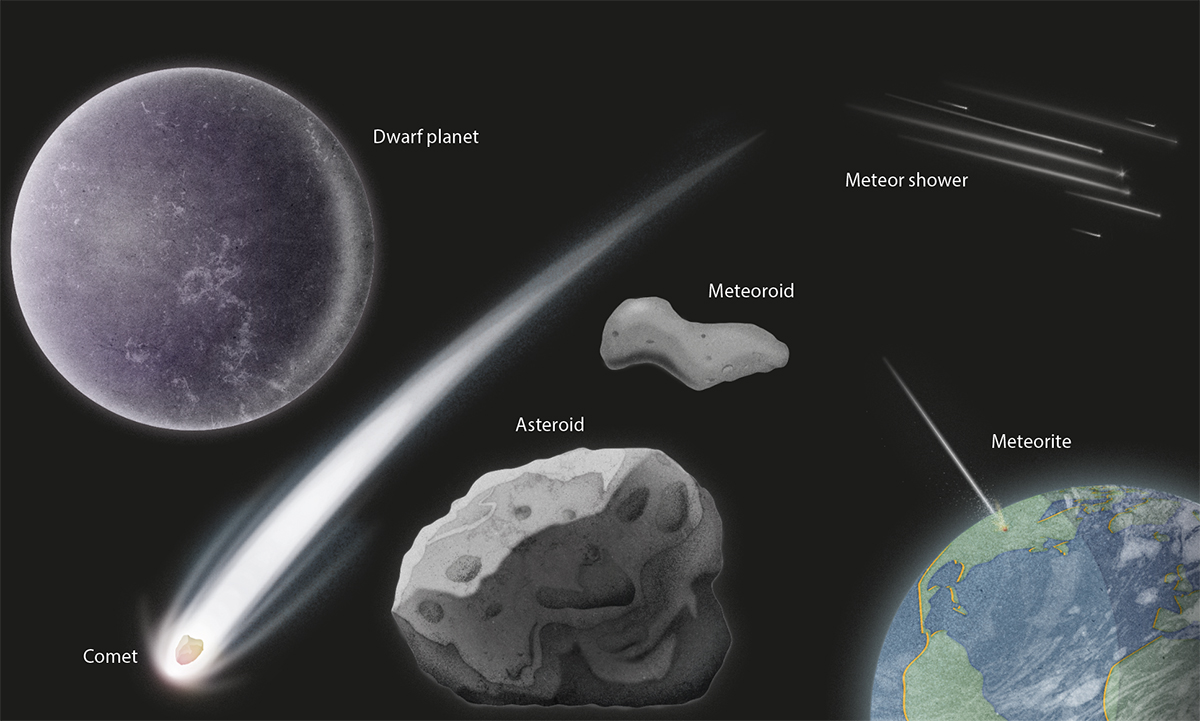
Think of an asteroid as a giant space boulder. These are massive chunks of rock, metals, and minerals left over from the early formation of our solar system roughly 4.6 billion years ago.
Most asteroids in our solar system live in a massive ring called the Asteroid Belt, located between the orbits of Mars and Jupiter. They range in size from a few meters across to massive bodies hundreds of kilometers wide. Because they are made of dense rock and metal, they do not melt or grow “tails” when the Sun’s rays hit them.
2. Comets: The “Dirty Snowballs”
If asteroids are rocky boulders, comets are cosmic “dirty snowballs.” This is where the biggest difference between asteroid, comet, and meteor lies.
Comets originate from the deepest, freezing outer edges of our solar system (the Kuiper Belt and Oort Cloud). Because it is so cold out there, comets are made entirely of frozen gases, ice, and dark dust.
When a comet’s orbit brings it closer to the inner solar system, an incredible action-reaction physics event happens. The intense heat and solar wind from the Sun cause the comet’s ice to instantly vaporize into a gas (a process called sublimation). This creates a massive, glowing atmosphere around the comet called a coma, and pushes the dust backward to form a spectacular, glowing tail that can stretch for millions of miles!
Want to hunt for comets in the night sky? Because they are often large but faint, wide-field optics are better than high-magnification telescopes. The Celestron SkyMaster 15×70 Binoculars are our absolute favorite tool for comet hunting. Check the current price on Amazon here!
3. Meteoroids, Meteors, and Meteorites
This is the category that causes the most confusion, but it is actually just the same object going through three different stages.
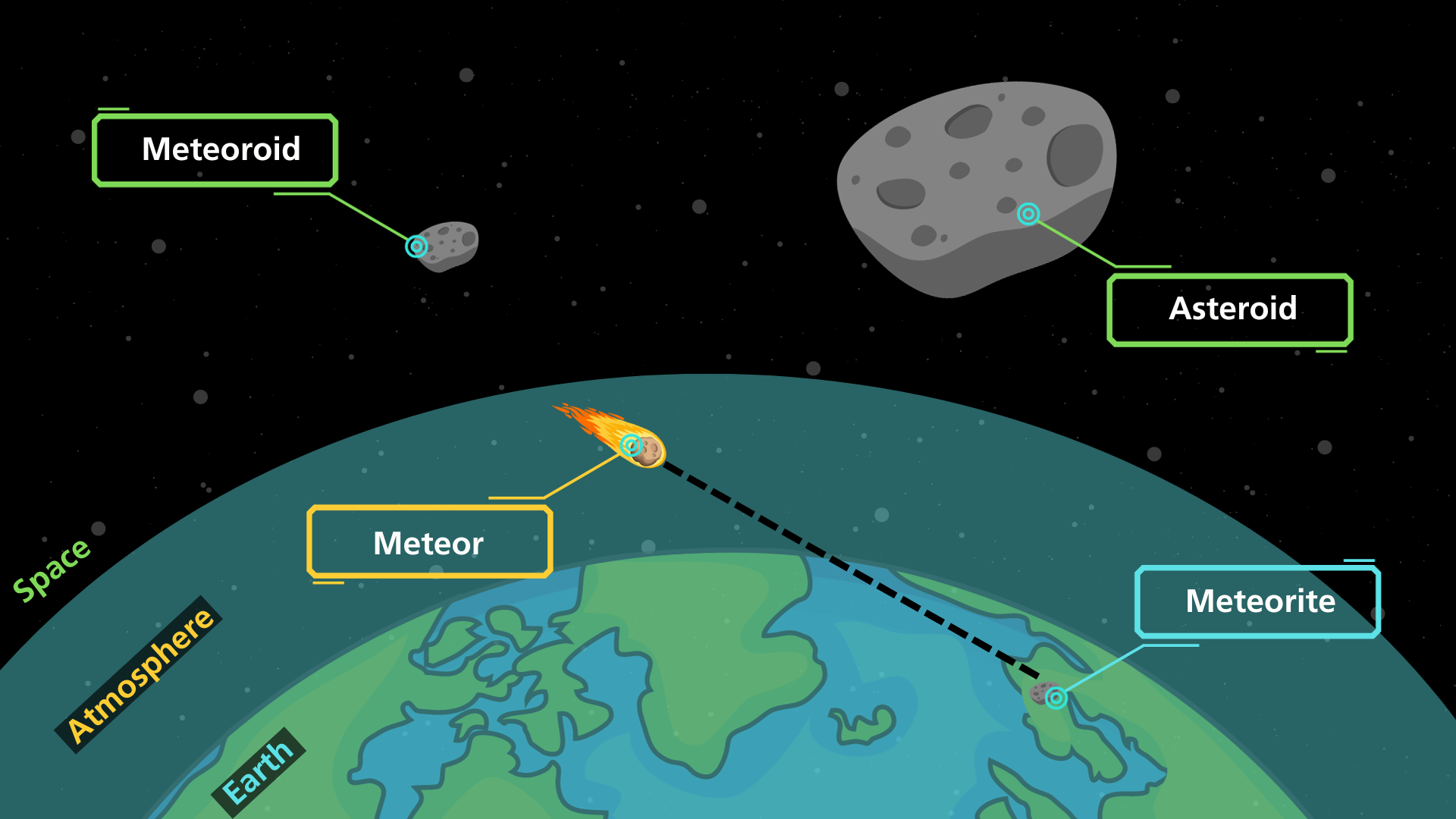
- Meteoroid: This is a small piece of debris floating through space. It is usually a piece of rock that broke off from an asteroid collision, or a dust trail left behind by a passing comet.
- Meteor: When a meteoroid gets too close to Earth and gets pulled in by our gravity, it hits our atmosphere at thousands of miles per hour. The intense friction causes the air around it to ignite. That glowing streak of light is the meteor (what we commonly call a shooting star).
- Meteorite: If the meteoroid is large enough that it doesn’t completely burn up, and a physical piece of rock actually crashes into the Earth’s surface, that surviving rock is called a meteorite.
So, to summarize the difference between asteroid, comet, and meteor: Asteroids are rocky, comets are icy, and meteors are the fiery flashes in our sky!
Build a Space Lab at Your School!
Do you want to move beyond textbook definitions and give your students a hands-on physics education?
Contact Astrophiles today to consult on our custom School Space Lab Setup services. We will help you source the perfect telescopes and design curriculum to turn abstract astronomy concepts into real-world observations!
This is so cool I had absolutely no idea about these differences, and now I feel like I understand a little bit better what’s actually happening when I’m looking at the night sky. I love the part about comets being icy bits from the outer limits of our solar system that sublime when approaching us… it’s very beautiful and poetic ☺️ Thank you for those precious explanations 🙏