
The Total Solar Eclipse August 12 2026 is set to be the most significant celestial event of the decade for Europe. Marking the first time in 27 years that mainland Europe will witness totality, this Total Solar Eclipse August 12 2026 offers a rare “sunset corona” that stargazers won’t want to miss. For those in the United States, a partial eclipse will also be visible.
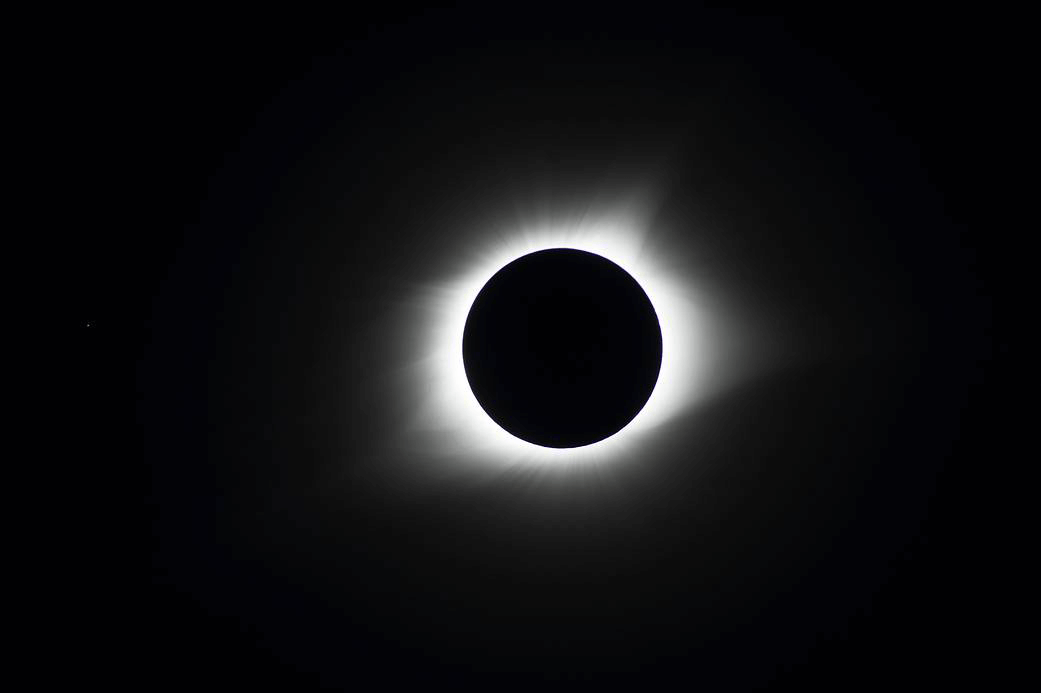
2026 Eclipse Quick-Fact Table
| Key Detail | Information |
| Date | Wednesday, August 12, 2026 |
| Path of Totality | Russia, Greenland, Iceland, Spain, Portugal |
| Max Totality Duration | 2m 18s (Western Iceland) |
| Indian Standard Time | Totality starts approx. 11:15 PM IST (Aug 12) |
| Next Total Eclipse | August 2, 2027 (Spain, North Africa & the Middle East) |
Why the 2026 Eclipse is a “Must-See”?
We’ve been waiting since 1999 for a moment like this. While the 2024 eclipse belonged to North America, 2026 is Europe’s turn to go dark. For those of us at Astrophiles, this isn’t just another celestial event—it’s the “Golden Hour Eclipse.”
Because the eclipse happens so late in the day, the sun will be hanging low on the horizon. This creates a rare photographic opportunity where the blacked-out sun (the corona) will be surrounded by the orange and pink hues of a Mediterranean sunset. It’s the kind of visual that only happens once in a lifetime.
Where to Watch the Total Solar Eclipse August 12 2026
Choosing your viewing spot is a trade-off between the length of the darkness and the clarity of the sky. Here is how we see the two main options:
Iceland: The Dramatic Edge
If you want the longest possible time in the shadow, Iceland is your destination. At the Látrabjarg cliffs, you’ll get over two minutes of totality.
-
The Vibe: Dramatic, volcanic, and raw.
-
The Risk: The weather in Iceland is notoriously unpredictable. There is roughly a 60% chance of clouds, so you have to be ready to drive to a clear patch at a moment’s notice.
Spain: The Sunny Choice
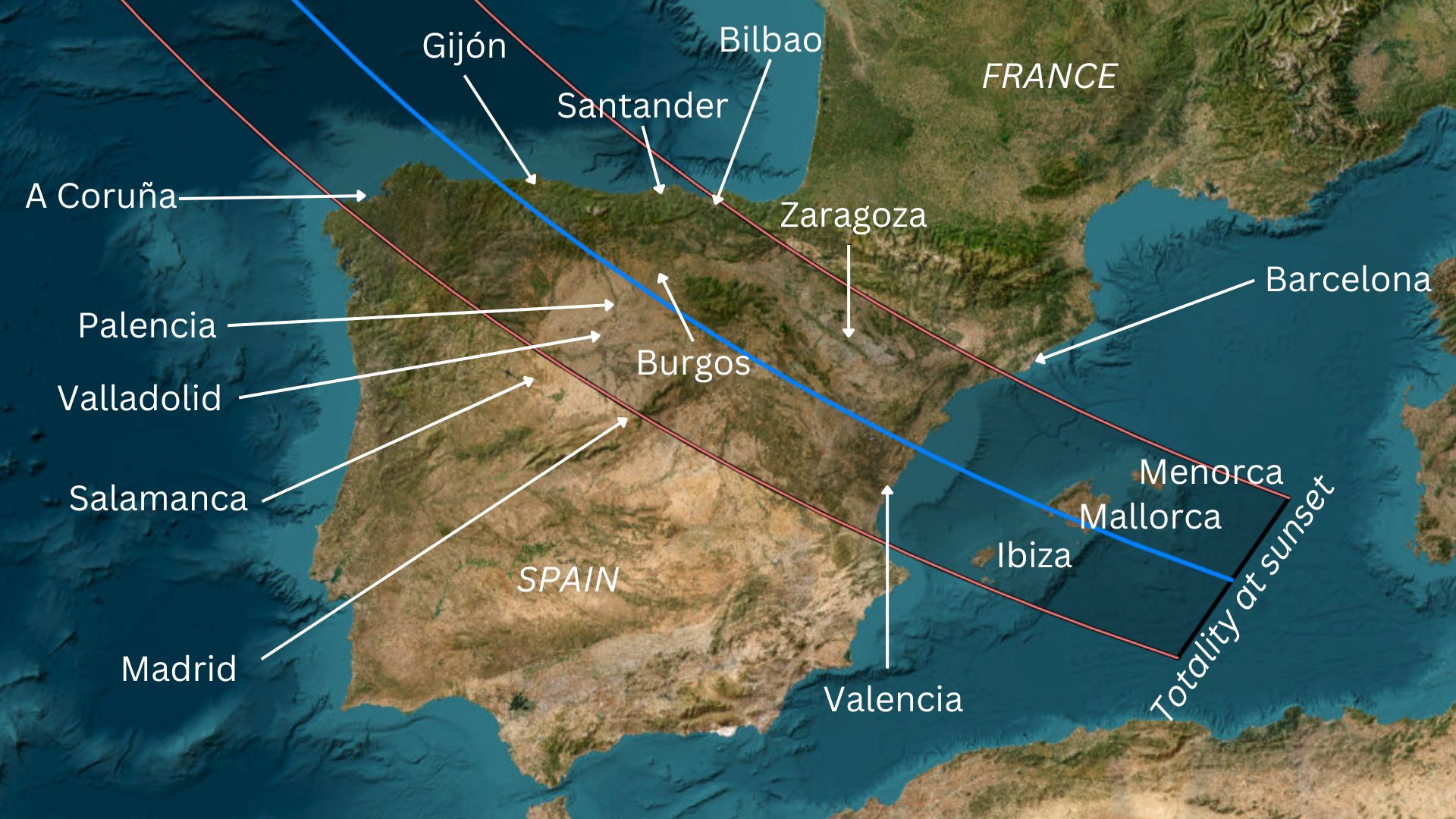
Most of our team is eyeing Spain for its reliability. The path of totality cuts right through the heart of the country, from the northern coast down toward the Mediterranean.
-
The Vibe: Warm, festive, and clear.
-
The Risk: In Spain, the sun will be extremely low—between 2° and 10° above the horizon. This means if you are standing behind a tall building or a mountain, you will miss the whole thing! You need a perfectly flat western horizon or a high vantage point.
Totality Timings (August 12, 2026)
Here is when the darkness hits major cities:
-
Reykjavik, Iceland: 17:48 GMT | Duration: 1m 00s
-
A Coruña, Spain: 20:27 CEST | Duration: 1m 16s
-
Zaragoza, Spain: 20:29 CEST | Duration: 1m 24s
-
Palma, Mallorca: 20:31 CEST | Duration: 1m 30s (Eclipse occurs at sunset)
What Will the Rest of Europe See?
While the path of totality is narrow, the vast majority of Europe will experience a very deep partial solar eclipse. A partial eclipse will cover more than 90% of the Sun in Ireland, Great Britain, Portugal, France, Italy, and the Balkans.
If you are not in the path of totality, here is the approximate maximum coverage you can expect to see in some major European areas:
-
United Kingdom and Ireland: Viewers will see a massive 90% to 96% of the Sun covered by the Moon. This will be the most coverage seen from the UK since the famous 1999 eclipse.
-
France, Switzerland, Belgium, and Northern Italy: Spectators in these areas will experience a very deep partial eclipse, with coverage ranging between 88% and 95%.
-
The “Sunset” Effect: For many locations in Europe (including France, Germany, Poland, and Italy), this deep partial eclipse will be occurring right as the sun is setting, offering incredible photography opportunities. In Warsaw, Poland, for example, the sun will be 83% eclipsed as it sets.
Note: viewers looking at a partial eclipse must use ISO 12312-2 certified eclipse glasses the entire time, even if it is near sunset.
Can You See the August 12, 2026 Eclipse in the US?
Although the August 12 event is classified as a total solar eclipse, the total phase will not reach the United States. However, people in the Northeast and other parts of the northern US will see a partial eclipse. During this time, the moon will pass in front of only part of the sun. NASA’s visibility area for this partial eclipse includes parts of the northern United States from Alaska to North Carolina, as well as most of Canada.
According to NASA, viewers in the US will see a small “bite” taken out of the sun, rather than the dramatic darkness associated with totality. The sky will not become completely dark, and there will be no period when it is safe to look directly at the sun without proper eye protection.
The partial eclipse will begin around midday in the northern contiguous United States. It will linger into the midafternoon for viewers farther east.
How to Watch the Eclipse Online (India & US)
Unfortunately, the August 12 eclipse will not be visible from the Indian subcontinent as it occurs during our nighttime. For those in the US who cannot see totality, you don’t have to miss out! We will be hosting a Live Sky-Watch on Astrophiles, linking up with observers on the ground in Spain to bring the “Golden Corona” directly to your screens in real-time. NASA will stream the eclipse live starting at 1:15 p.m. EDT on Aug. 12 at nasa.gov/live.
Safety Checklist for the Total Solar Eclipse August 12 2026

- Safety First: You must use ISO 12312-2 certified eclipse glasses until the sun is 100% covered. Because the eclipse will remain partial throughout the Northeast US, viewers there must use safe solar-viewing glasses or a handheld solar viewer the entire time.
- Photography: If you’re using your phone, grab a clip-on solar filter now.
Frequently Asked Questions (FAQ)
What time is the total solar eclipse on August 12, 2026?
In Iceland, totality begins around 17:44 GMT. In Spain, it starts later in the evening, around 20:26 CEST.
Where is the best place to see the 2026 eclipse?
The path of totality crosses Russia, Greenland, Iceland, Spain, and Portugal. Iceland offers the longest duration, while Spain offers better chances of clear skies and a unique “sunset eclipse”.
How much of the August 12, 2026 eclipse will be visible in the US?
Viewers in the US will only see a partial eclipse, meaning the sky will not go dark. In cities like Boston and New York, the moon will cover between 9% and 16% of the sun. The best views in the US will be in Anchorage, Alaska, where the moon will cover about 28% of the sun.
How do I safely watch the 2026 solar eclipse?
You must use ISO 12312-2 certified eclipse glasses whenever you are looking directly at the sun, especially during the partial phases of the eclipse. Never look at the sun through a camera lens, telescope, or binoculars while wearing eclipse glasses, as the concentrated rays can burn through the filter. A special solar filter must be attached to the front of any optical device.
1 thought on “Total Solar Eclipse August 12, 2026: The Ultimate Guide for Europe and US Viewers”