

The Saturn opposition 2026 is the most anticipated planetary event of the year for backyard astronomers. On October 4, Earth will pass directly between the Sun and Saturn, bringing the spectacular ringed gas giant to its closest, brightest, and largest point in our night sky.
If you have ever wanted to see Saturn’s rings with your own eyes, this is the exact window to do it. During opposition, Saturn is visible all night long, rising in the east right as the Sun sets in the west. Whether you are setting up a small beginner telescope on your driveway or planning a school astronomy workshop, here is your complete guide to maximizing the 2026 Saturn opposition.
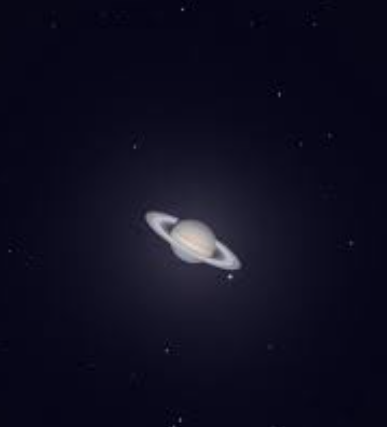
What Happens During a Saturn Opposition?
A Saturn opposition occurs when Earth flies directly between the Sun and Saturn, placing the two planets on the exact same side of the solar system.
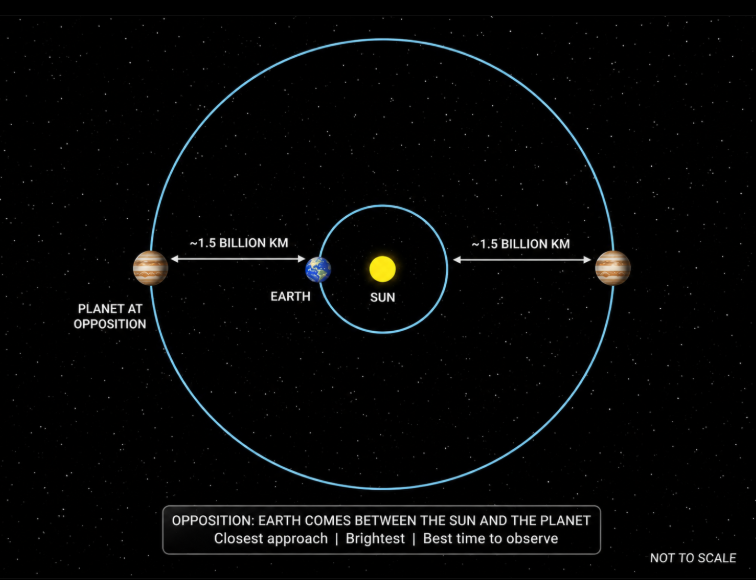
Because Saturn is opposite the Sun in our sky during this time, three things happen:
-
Maximum Brightness: Sunlight reflects directly off Saturn’s atmosphere and rings back to Earth, making it shine at a brilliant magnitude of 0.3 (brighter than most stars).
-
All-Night Visibility: The planet rises in the east at sunset, reaches its highest point around midnight, and sets in the west at sunrise.
-
Maximum Size: Saturn comes to its closest physical approach to Earth. In 2026, it will be roughly 784 million miles (8.43 Astronomical Units) away, making its disk appear a massive 19.7 arcseconds across in a telescope eyepiece.
When is Saturn Closest to Earth in 2026? Saturn opposition 2026
Saturn will reach opposition and its closest point to Earth on Sunday, October 4, 2026, at exactly 12:00 UTC (7:00 a.m. CDT).
However, you do not need to observe it at that exact minute! Saturn will remain exceptionally bright and well-placed for evening observation from late August all the way through mid-November.
-
Where will Saturn be in 2026? It will spend the opposition shining prominently in the constellation Cetus (The Whale).
-
Best Time to View: While it is visible all night, the absolute best time to look through a telescope is around midnight local time. This is when Saturn reaches its highest altitude in the southern sky, allowing you to look through the thinnest, least turbulent layer of Earth’s atmosphere for the sharpest views.
Tracking the exact path of the Saturn opposition 2026 ensures you will not miss the peak visibility window when the planet is highest in the sky.
The 2026 Ring Tilt: A Rare Perspective
Expert Insight: If you look at photos of Saturn from 2017, the rings look wide open. But Saturn has a 29.4-year orbit, meaning our viewing angle of its rings slowly tilts over time. Last year (March 2025), we experienced a “ring plane crossing” where the rings were perfectly edge-on and virtually invisible.
During the October 2026 opposition, Saturn’s rings will be tilted at an angle of just -7.5 degrees. This means we are currently looking at Saturn’s southern hemisphere. While the rings will look like a narrow, sharp needle slicing through the planet rather than a wide bowl, this shallow angle is actually a massive advantage for observers. Because the rings are not blocking the planet’s globe, 2026 is one of the best years to spot atmospheric cloud bands on Saturn’s surface!
Essential Telescope Gear for Saturn
Unlike meteor showers, you absolutely cannot see Saturn’s rings with the naked eye or standard binoculars. You need a telescope.
Field Experience: The biggest mistake beginners make is rushing outside with a warm telescope. Before you observe Saturn, set your telescope outside for at least 45 minutes to achieve “thermal equilibrium.” If the mirror is warmer than the night air, heat waves will rise inside the optical tube, making Saturn look like a blurry, boiling mess.
To see the Cassini Division (the dark gap in the rings) and Saturn’s largest moon, Titan, here is the gear you need:
-
A Planetary Refractor Telescope: You need a telescope with an aperture of at least 70mm to 90mm to resolve the rings clearly. 90mm Refractor Telescope for Planetary Viewing
-
A 2x Barlow Lens: Planets require high magnification. A Barlow lens instantly doubles the magnification power of any eyepiece you already own, allowing you to zoom in on Saturn’s disk. 1.25-inch 2x Barlow Lens Kit
-
Smartphone Adapter: Want to take a picture of Saturn through the eyepiece? Holding your phone by hand is incredibly frustrating. A mechanical clamp keeps your phone lens perfectly aligned. Smartphone Telescope Eyepiece Adapter Mount
(Note: Are you a teacher or trust director looking to upgrade your school’s STEM lab for planetary astronomy? Check out our complete B2B procurement guide on the 5 Best Telescopes for Schools in India.
Frequently Asked Questions (FAQ)
How often is Saturn in opposition?
Saturn comes to opposition roughly every 378 days (about once a year and two weeks). Because it takes Saturn nearly 30 Earth years to orbit the Sun, Earth easily “laps” Saturn on the inside track once a year.
What happens during the Saturn opposition 2026?
During opposition, Earth sits exactly between the Sun and Saturn. This alignment means Saturn is at its closest point to Earth for the year, appears at its absolute brightest, and is visible in the sky all night long.
Which planets will be in opposition in 2026?
Alongside Saturn in October, Jupiter will reach its spectacular opposition later in the year. Mars, however, does not reach opposition in 2026, as its next major close approach happens in early 2027.
Where will Saturn be located in 2026?
During its 2026 opposition, Saturn will be located in the constellation Cetus (The Whale), shining brightly in the southern sky for Northern Hemisphere observers around midnight.
If you want to prepare your gear for the Saturn opposition 2026, start aligning your finderscope and practicing your focus now.