
Every October, Earth flies through a massive debris trail left behind by one of the most famous objects in astronomical history: Halley’s Comet. Because it is a Halley’s comet meteor shower, the Orionid meteor shower 2026 is one of the most anticipated events of the year. As these tiny cosmic dust particles slam into our atmosphere at a blistering 66 kilometers per second, they burn up, creating brilliant streaks of light. If you want to know how to watch Orionids this year, tracking the exact Orionids 2026 peak date and avoiding the moon glare is crucial.
While some generic astronomy sites and automated calendars are incorrectly reporting that 2026 offers a perfectly dark sky for this shower, that is simply not true. You will be dealing with a bright, waxing gibbous moon during the peak. However, do not let that discourage you! With the right timing and a few field-tested tricks, you can easily beat the lunar glare and catch 15 to 25 meteors per hour.
Here is your complete guide to watching the 2026 Orionids, tracking the radiant, and staying warm.
When is the Orionid Meteor Shower 2026 Peak?
The Orionids are active from early October through November 7, but the shower reaches its absolute maximum on the night of October 21 into the early morning of October 22, 2026.
Tracking the moonset is the ultimate secret to successfully viewing the Orionid meteor shower 2026.
What is the best time to watch?
Because the constellation Orion does not rise high into the sky until late at night, the absolute best viewing window across all time zones (US, UK, and Australia) is between 3:00 AM and dawn on October 22.
There is a highly strategic reason to wait until 3:00 AM this year, which brings us to the moon.
The 2026 Moon Phase “Problem” (And How to Beat It)
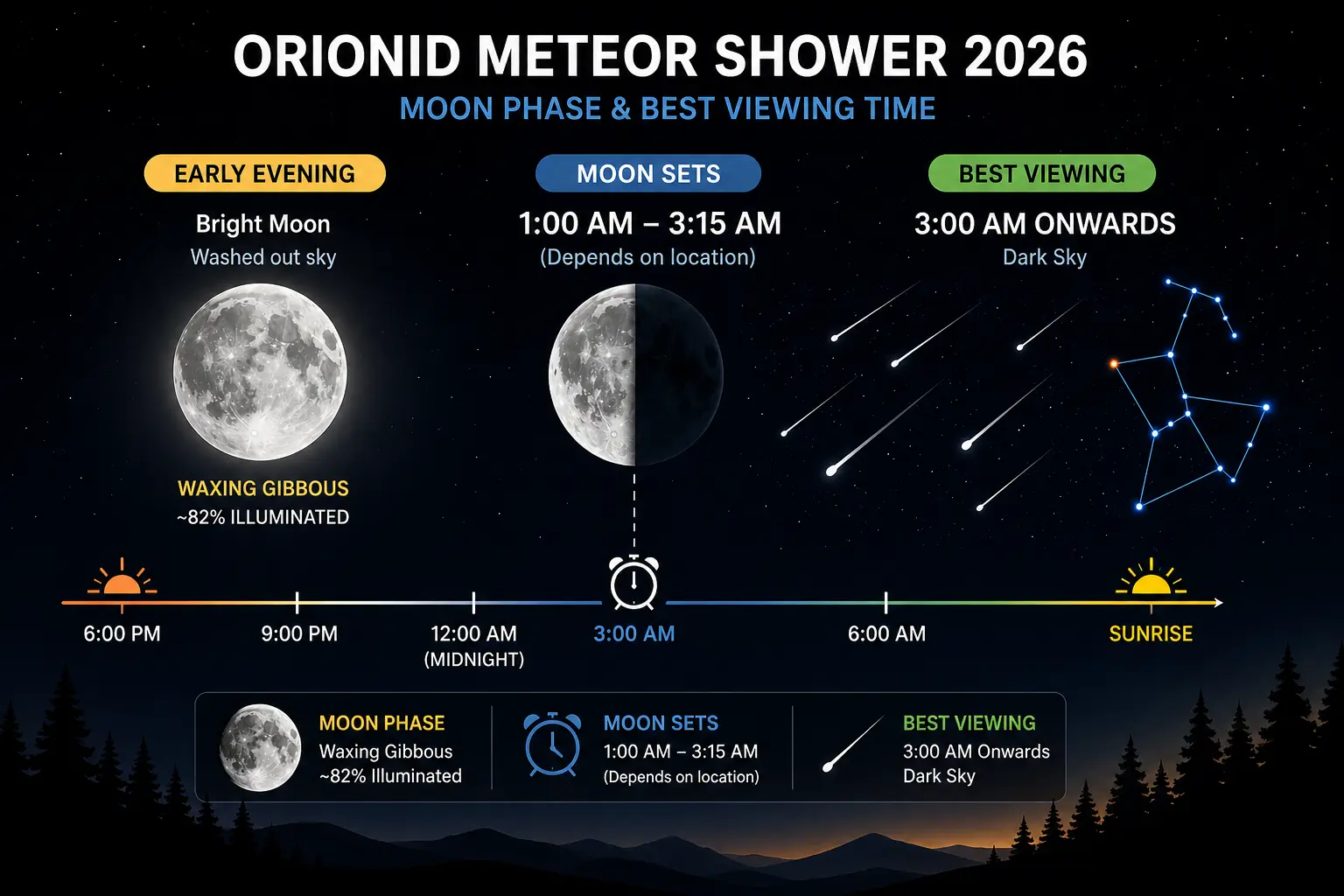
Expert Insight: A lot of generic calendars will tell you the 2026 Orionids are ruined by the moon. Let’s look at the actual math. On October 21, the moon is a bright waxing gibbous (roughly 78% to 87% illuminated depending on your time zone). If you go out at midnight, the sky will be completely washed out.
However, the moon sets between 1:00 AM and 3:15 AM local time (depending on your specific latitude). For example, in New York, the moon sets at exactly 3:12 AM.
If you set your alarm for 3:00 AM, the moon will drop below the horizon, plunging the sky into total darkness just as the constellation Orion reaches its highest point in the sky. This gives you roughly two to three hours of pristine, dark-sky viewing before the morning twilight begins.
Where to Look: Finding the Radiant
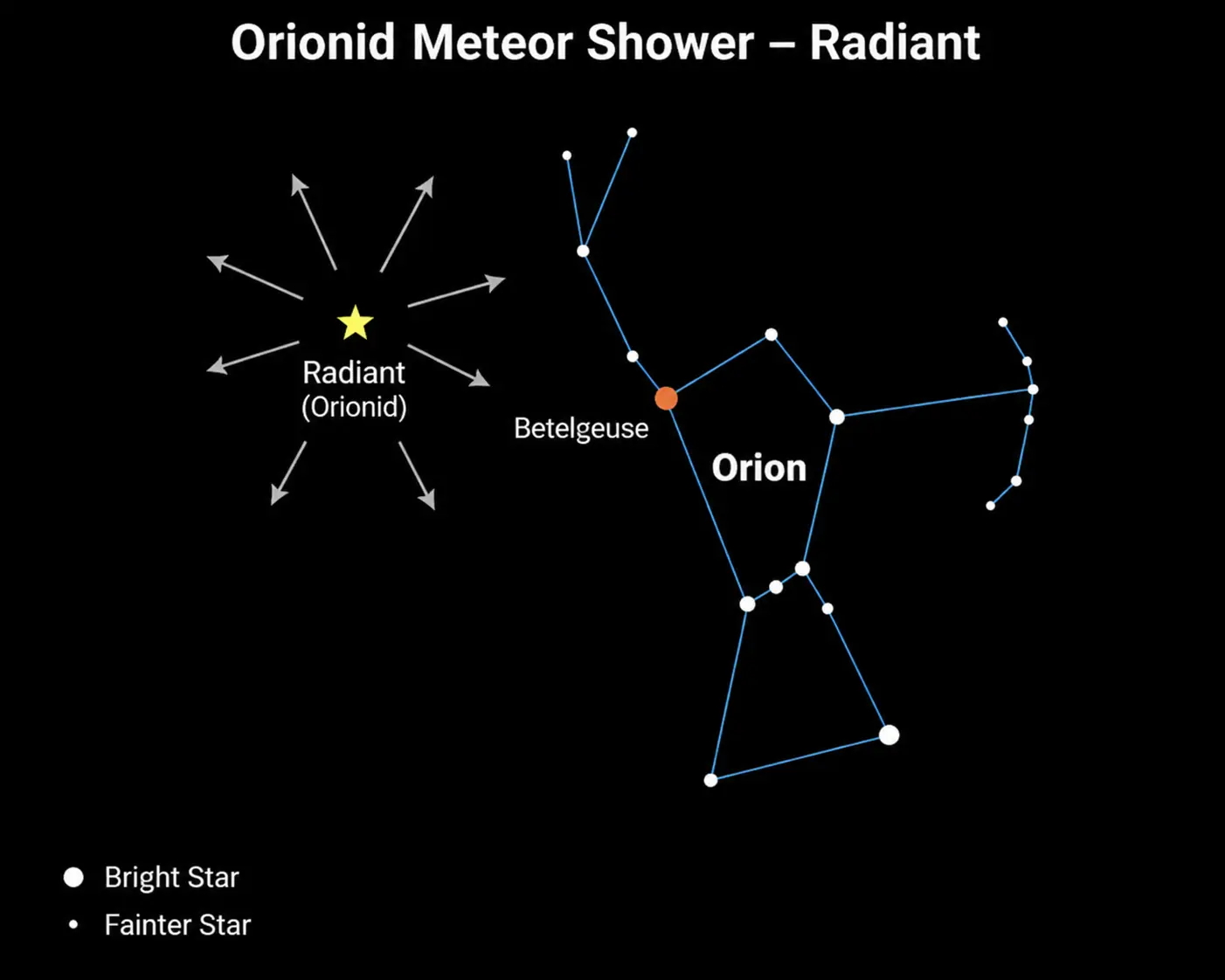
The Orionid meteor shower 2026 gets its name because the meteors appear to originate (or radiate) from the constellation Orion the Hunter. If you are wondering where to look for Orionids, they specifically radiate from just north of the bright red star Betelgeuse, near Orion’s upraised club. Scanning this area is the best way to catch the Orionid meteor shower 2026.
Where to look: Face towards the southeast (or east, if you are in the Southern Hemisphere), but do not stare directly at Orion.
Meteors that appear right next to the radiant point will look like short, stubby flashes because they are coming straight at you. To see the longest, most dramatic streaks—and the glowing “persistent trains” the Orionids are famous for—look roughly 45 degrees away from Orion, scanning the darkest patches of the sky.
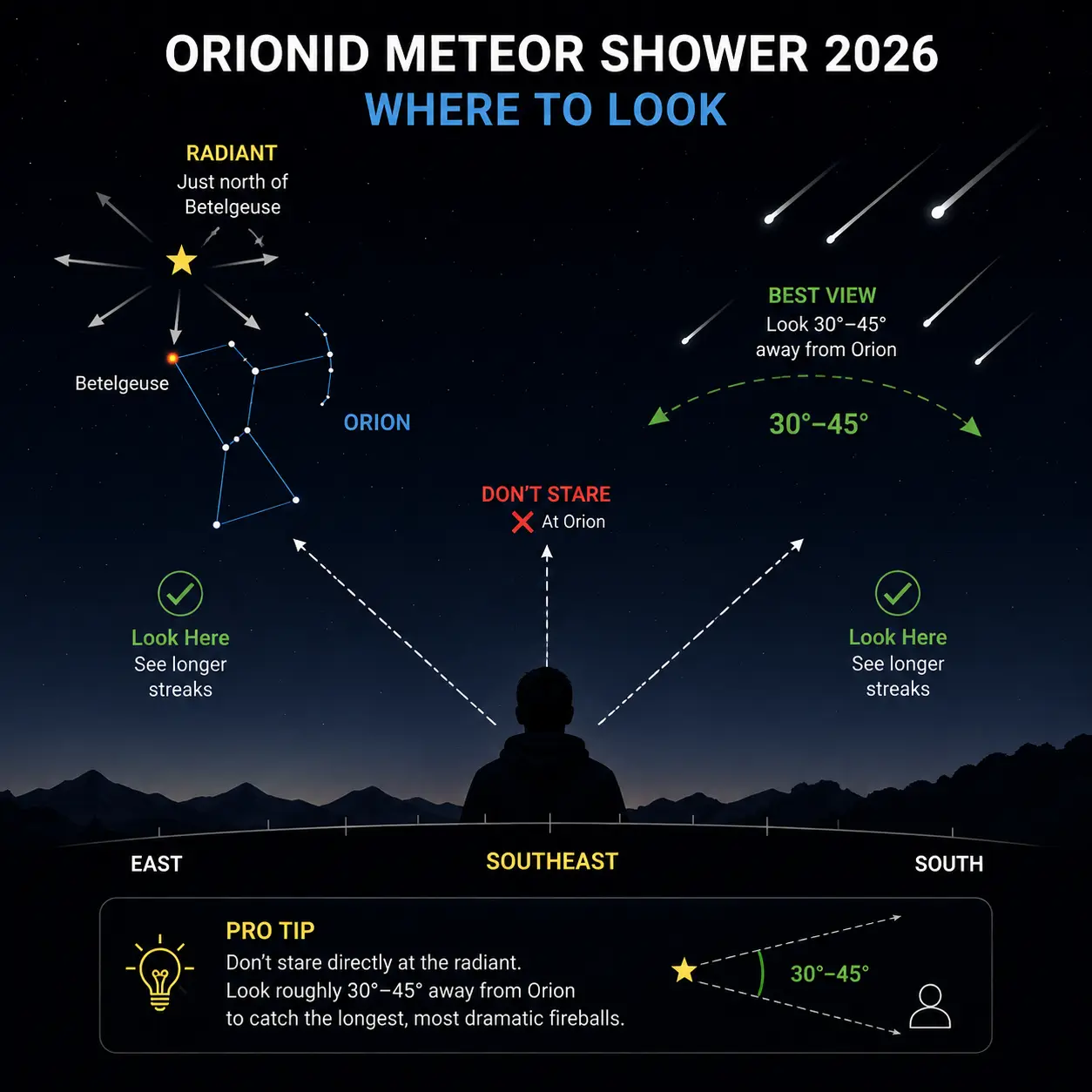
To get the most out of the Orionid meteor shower 2026, remember to scan the darkest parts of the sky away from the radiant.
Essential Gear for Cold-Weather Stargazing
By late October, the midnight air is sharply cold in the Northern Hemisphere. A telescope is actually counterproductive for meteor showers because it physically restricts your field of view. Instead, your budget should go toward keeping yourself warm and comfortable so you can stay outside longer. Staying warm is the only way to fully enjoy the Orionid meteor shower 2026 during those chilly pre-dawn hours.
-
Zero-Gravity Lounge Chair: Staring straight up while standing will ruin your neck in 15 minutes. A reclining chair is the single most important tool for meteor hunting. Reclining Outdoor Zero Gravity Chair
-
Insulated Sleeping Bag / Blanket: Because your body is generating zero heat while sitting still, a standard living room blanket will not cut it. Invest in a dedicated camping quilt. Cold Weather Stargazing Camping Blanket
-
Red Light Headlamp: If you need to check your star map or grab a thermos, using a standard white flashlight will destroy your night vision. A red-light headlamp is mandatory. Astronomer’s Red Light Headlamp
Note: Planning ahead for the end of the year? Check out our complete The Ultimate 2026 Meteor Shower Calendar to see what is coming next!
Frequently Asked Questions (FAQ)
Are the Orionids really from Halley’s Comet?
Yes. The Orionids are formed by ancient dust and debris shed by Halley’s Comet (1P/Halley) during its past trips around the Sun. Earth also passes through another part of this comet’s debris trail in May, creating the Eta Aquariid meteor shower.
Will I see Halley’s Comet itself?
No. Halley’s Comet has a 76-year orbit and last visited the inner solar system in 1986. It will not return to our skies until 2061. Watching the Orionid meteor shower 2026 is the closest you can get to seeing pieces of the comet right now.
How many meteors will I see during the Orionid meteor shower 2026?
Under ideal, dark-sky conditions between 3:00 AM and dawn, observers can expect to see roughly 15 to 25 meteors per hour. Because the Orionid meteor shower 2026 meteors are incredibly fast, they frequently leave behind glowing trails of ionized gas that hang in the sky for several seconds.