What are the best telescopes for schools in India? Selecting optical equipment for an educational institution is vastly different from buying a personal hobby setup. School telescopes must endure handling by hundreds of students, operate smoothly during quick class periods, and offer automated tracking so objects don’t drift out of view during long queues.
When looking to invest institutional funds, school boards and science educators consistently search for the best telescopes for schools in India to ensure long-term durability.
Having led astronomy outreach campaigns for over 10,000 students across Maharashtra, from 7,200-student workshops in Dharashiv to multi-school deployments in Jalna. Our team at Astrophiles has tested optics across every possible field environment.
Whether you are equipping a basic STEM laboratory or establishing a permanent campus observatory, here is our definitive buying guide to the top telescopes for Indian educational institutions in 2026.
At a Glance: Top School Telescope Recommendations
|
Category / Award |
Model & Mount Combo |
Optical Type |
Best Feature for Schools |
Price Range (Est.) |
|---|---|---|---|---|
|
1. Best Overall for Schools |
SVBONY SV503 102mm ED + Sky-Watcher EQ-AL55i Pro |
ED Doublet Refractor |
Maintenance-free, high-contrast planetary views |
₹1,68,000 – ₹1,75,000 |
|
2. Best High-Aperture Powerhouse |
Sky-Watcher 200mm (8″) Reflector + HEQ5 Pro GoTo |
Newtonian Reflector |
4\times more light gather for faint nebulae/galaxies |
₹2,15,000 – ₹2,50,000 |
|
3. Best for Research & Astrophotography |
SVBONY SV550 122mm APO + iOptron CEM26 Mount |
Triplet Apochromatic |
Zero color fringing, publication-grade imaging |
₹3,38,000 – ₹4,00,000 |
|
4. Best Portable Widefield Setup |
William Optics MiniCat 51 + Sky-Watcher EQ-AL55i |
Petzval Refractor |
1. Best Overall for Schools: SVBONY SV503 102mm ED + Sky-Watcher EQ-AL55i Pro
If your institution can only invest in a single telescope system, this is the gold standard configuration.
Refractors feature closed optical tubes, meaning dust cannot enter and the lenses never require manual mirror alignment (collimation). The 102mm Extra-Low Dispersion (ED) glass delivers crisp views of Saturn’s rings, Jupiter’s cloud bands, and lunar craters without rainbow-like color bleeding.
- Why it wins for schools: Paired with the Sky-Watcher EQ-AL55i Pro GoTo mount, teachers can select celestial targets directly from a smartphone or tablet via Wi-Fi. The motor automatically counteracts Earth’s rotation, keeping the target centered while dozens of students take turns at the eyepiece.
- Key Specs: 102mm Aperture | Focal Ratio f/7 | ED Glass | Wi-Fi GoTo Tracking
- Check Current Price: SVBONY SV503 102mm ED Telescope
- Check Mount Price: Sky-Watcher GoTo Mount
2. Best High-Aperture Powerhouse: Sky-Watcher 200mm (8-inch) Reflector + HEQ5 Pro
When the primary objective is visual impact during evening stargazing sessions, light-gathering power (aperture) matters most. An 8-inch mirror collects four times as much light as a standard 100mm refractor, making faint deep-sky objects like the Orion Nebula and Andromeda Galaxy pop with clarity.
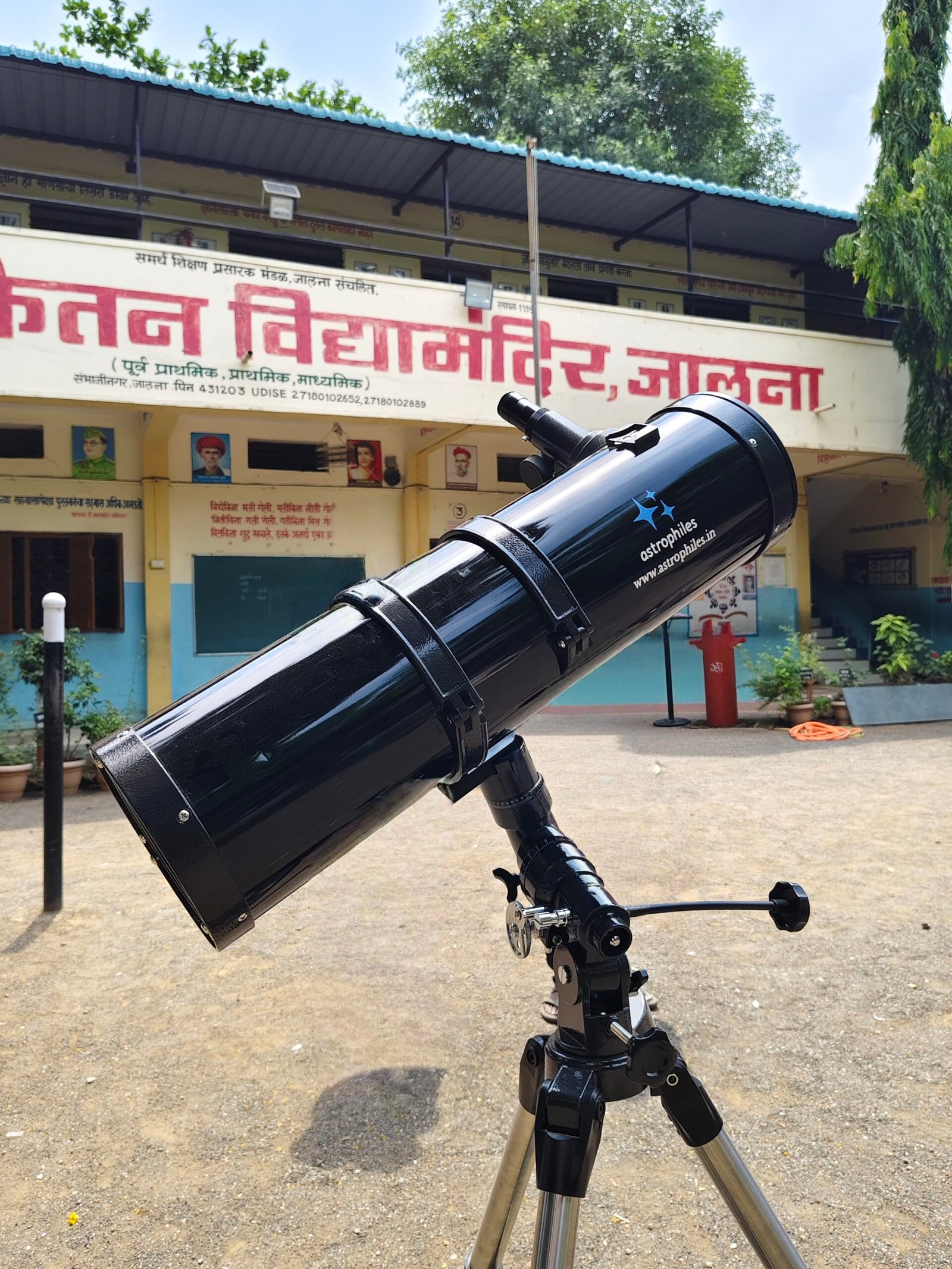
- Why it wins for schools: The dual-speed focuser allows students to achieve fine focal control. Because an 8-inch optical tube is heavier, it requires the industrial stability of the Sky-Watcher HEQ5 Pro GoTo mount to prevent image shake when students touch the eyepiece.
- Key Specs: 200mm Aperture | Focal Ratio f/5 | Dual-Speed Focuser | 13.7 kg Mount Payload
- Check Current Price: Sky-Watcher 200mm Reflector Telescope
- Check Mount Price: Sky-Watcher HEQ5 Pro Mount
3. Best for Student Research & Astrophotography: SVBONY SV550 122mm Triplet APO
For progressive high schools, junior colleges, or dedicated STEM research labs aiming to capture long-exposure celestial photographs, standard refractors won’t suffice. The SV550 features a three-lens (triplet) optical engine that completely eliminates chromatic aberration across the entire visual spectrum.
- Why it wins for schools: When paired with a center-balance GoTo mount like the iOptron CEM26, students can attach DSLR or dedicated astronomy cameras to collect scientific image data for projects and science fairs.
- Key Specs: 122mm Aperture | Focal Ratio f/7 | Triplet Apochromatic Lens | Aluminum Flight Case Included
- Check Current Price: SVBONY SV550 122mm Triplet APO Telescope
- Check Mount Price: iOptron CEM26 GoTo Mount
4. Best Portable Widefield Setup: William Optics MiniCat 51 WIFD + EQ-AL55i Pro
For schools that frequently travel to off-campus field sites, dark-sky camps, or rural outreach centers, portability is paramount. The MiniCat 51 features an internal focuser (WIFD) and a multi-element Petzval optical design, producing flat star fields right out of the box.

- Why it wins for schools: It is extremely lightweight and easy to deploy in minutes. While its small 51mm aperture limits high-power planetary viewing, it excels as an ultra-portable widefield astrophotography rig for field trips.
- Key Specs: 51mm Aperture | Focal Ratio f/4.9 | WIFD Internal Focuser | Petzval Optical Design
- Check Current Price: William Optics Telescopes
How to Choose the Best Telescopes for Schools in India
Before issuing a purchase order for your institution’s STEM lab, ensure your team evaluates these three non-negotiable factors:
1. Refractor vs. Reflector
- Refractors (Lens-Based): Best for general school use. Closed tube, highly durable, zero maintenance, excellent for planetary and solar viewing.
- Reflecting Telescopes (Mirror-Based): Best for high-aperture deep-sky viewing. Requires periodic mirror alignment (collimation) by trained staff.
2. Manual vs. Computerized GoTo Mounts
Manual mounts are fine for single users, but computerized GoTo mounts are mandatory for school groups. Earth rotates rapidly; without automatic motor tracking, a target like Saturn will drift out of the eyepiece field of view every 30 to 45 seconds, forcing teachers to constantly re-align the telescope manually instead of teaching.
3. Daytime Solar Viewing Safety
Since school hours take place during daylight, nighttime stargazing cannot be the only use case. Ensure your procurement order includes ISO-certified full-aperture solar filters. This enables safe daytime “Surya Darshan” workshops where students observe active sunspot dynamics directly on the Sun’s surface.
Need Help Designing Your School’s Space Laboratory?
Selecting hardware is only the first step. At Astrophiles, we assist educational institutions across India with complete space laboratory blueprints—from custom equipment procurement and physical assembly to comprehensive teacher training and syllabus-aligned curriculum design.
- See Our Field Operations: Read how we coordinated a Multi-Campus Astronomy Workshop in Jalna reaching 750 students in a single day.
- Request a Custom Lab Consultation: Contact our founding team to design a tailored observatory program for your campus.
Investing in the best telescopes for schools in India ensures your institution builds a sustainable, hands-on science legacy.
Equipping your campus with the best telescopes for schools in India lays the foundation for a thriving student science program.