
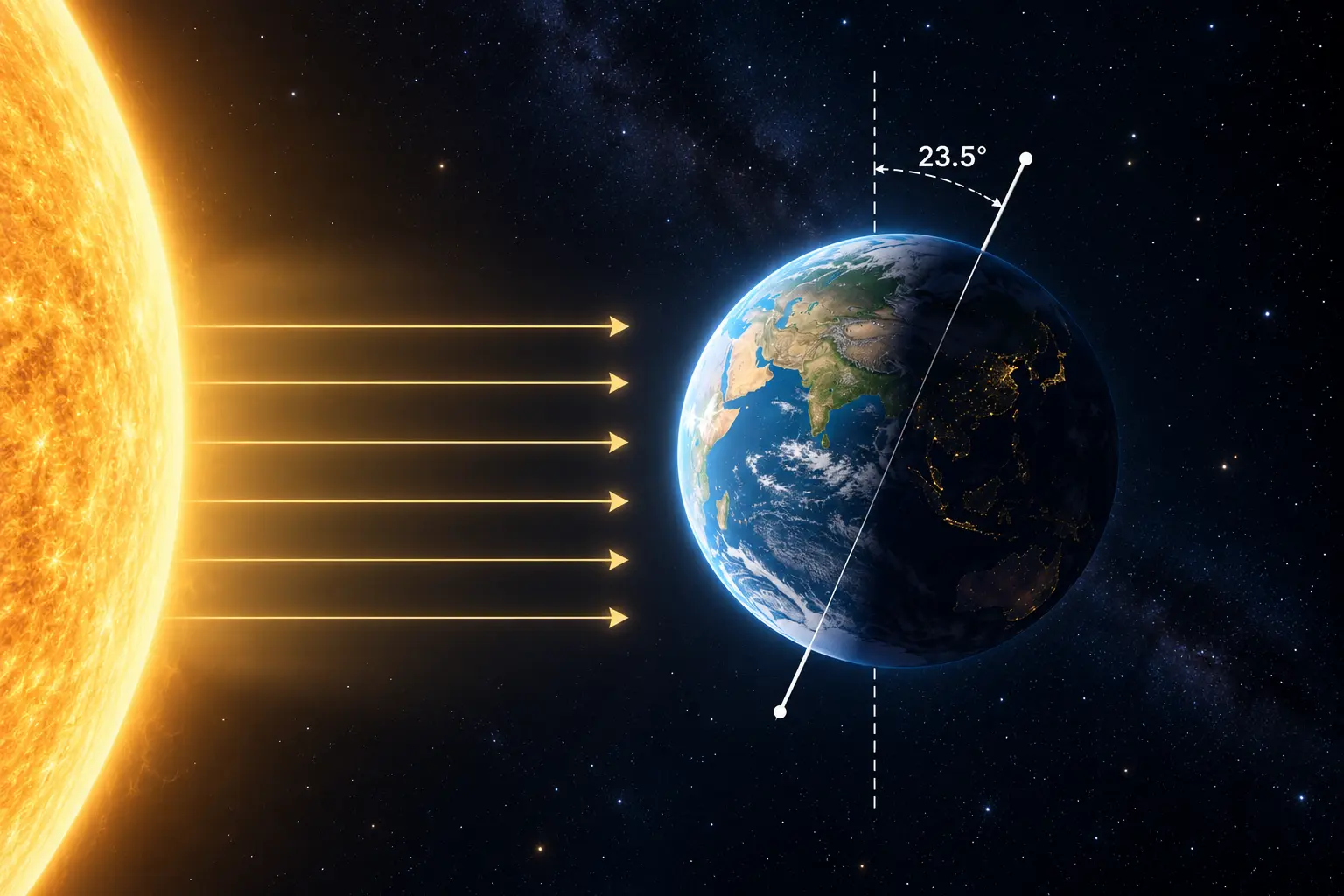
The December solstice is a pivotal moment in our orbital journey. For the Northern Hemisphere, the Winter Solstice 2026 marks the shortest day and longest night of the year. It is the exact moment when the North Pole is tilted its maximum of 23.5 degrees away from the Sun.
Whether you are an astronomy enthusiast observing the Sun’s low arc, an educator planning a STEM lesson, or simply wondering when winter officially begins, this guide provides the exact global timings and a hands-on experiment to measure solar angles using nothing but shadows.
When is the Winter Solstice 2026? (Global Times)
Fast Facts: Winter Solstice 2026
-
Exact Moment: December 21, 2026, at 20:50 UTC.
-
Event Definition: The Sun reaches its southernmost point in the sky, positioned directly over the Tropic of Capricorn.
-
Northern Hemisphere Effect: Marks the shortest day of the year and the official start of astronomical winter.
Because the solstice happens at a specific mathematical moment in Earth’s orbit, your local time depends on your time zone. Here is when the Winter Solstice 2026 officially occurs globally:
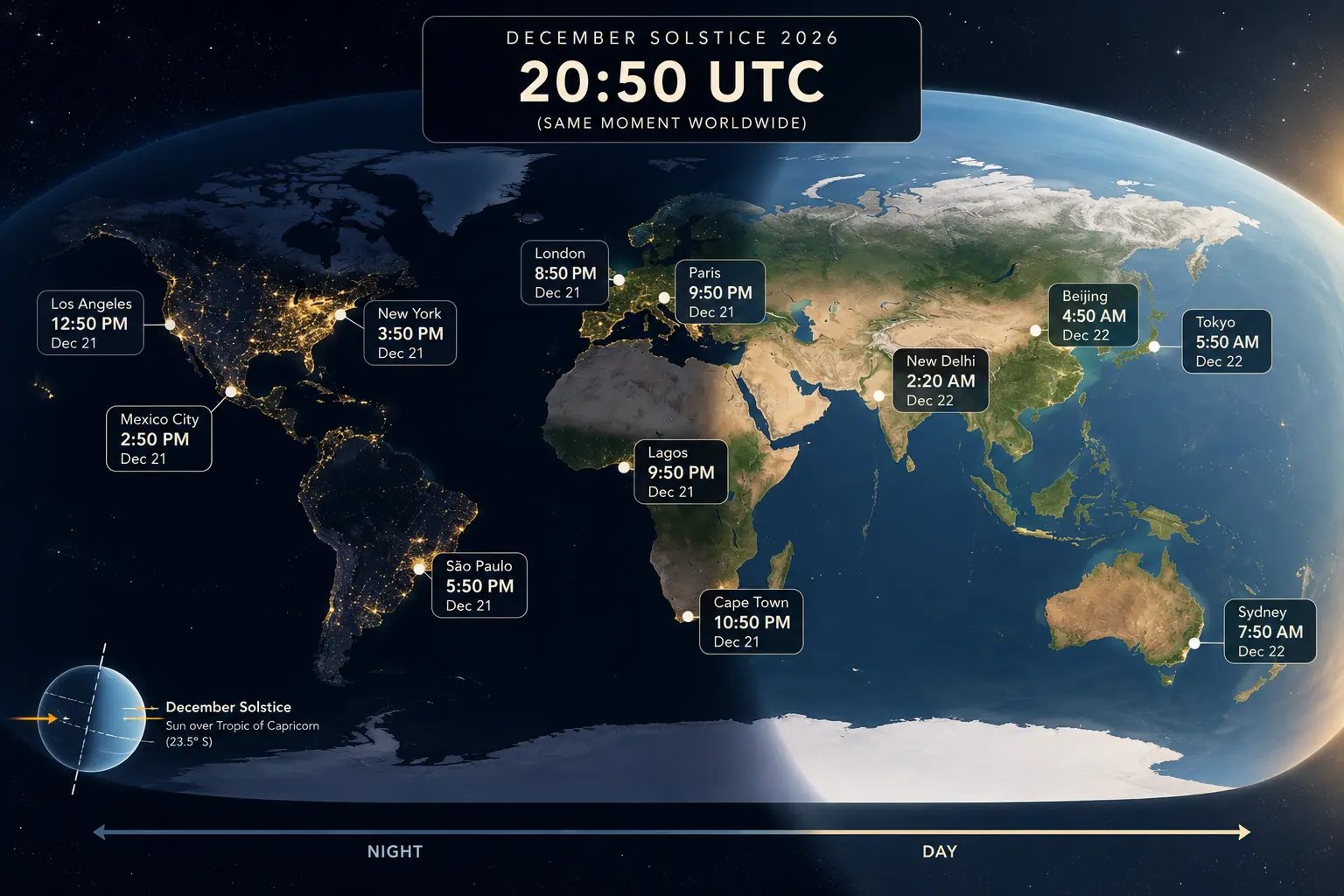
| Region | Local Time | Date |
| UTC (Coordinated Universal Time) | 20:50 | December 21, 2026 |
| New York, USA (EST) | 3:50 PM | December 21, 2026 |
| London, UK (GMT) | 8:50 PM | December 21, 2026 |
| New Delhi, India (IST) | 2:20 AM | December 22, 2026 |
Note for the Southern Hemisphere
If you are reading this from Sydney, Australia, December 21 is not your winter solstice! Because the Southern Hemisphere is tilted toward the Sun, December 21 marks your Summer Solstice the longest day of the year.
The Science of Extreme Shadows
Because the Sun takes its lowest, most southerly path across the sky on this day, the shadows cast at solar noon are the longest they will be all year.
For advanced students, you can calculate the exact maximum height (solar elevation angle) of the Sun at your location during the Winter Solstice 2026 using this standard astrophysical formula:
α = 90° – L – 23.5°
(Where alpha α is the solar elevation angle and L is your local latitude).
For example, if you are in New York at a latitude of 40.7°, the Sun will only reach a maximum angle of roughly 25.8° above the horizon at noon!
The Solstice Sundial Experiment
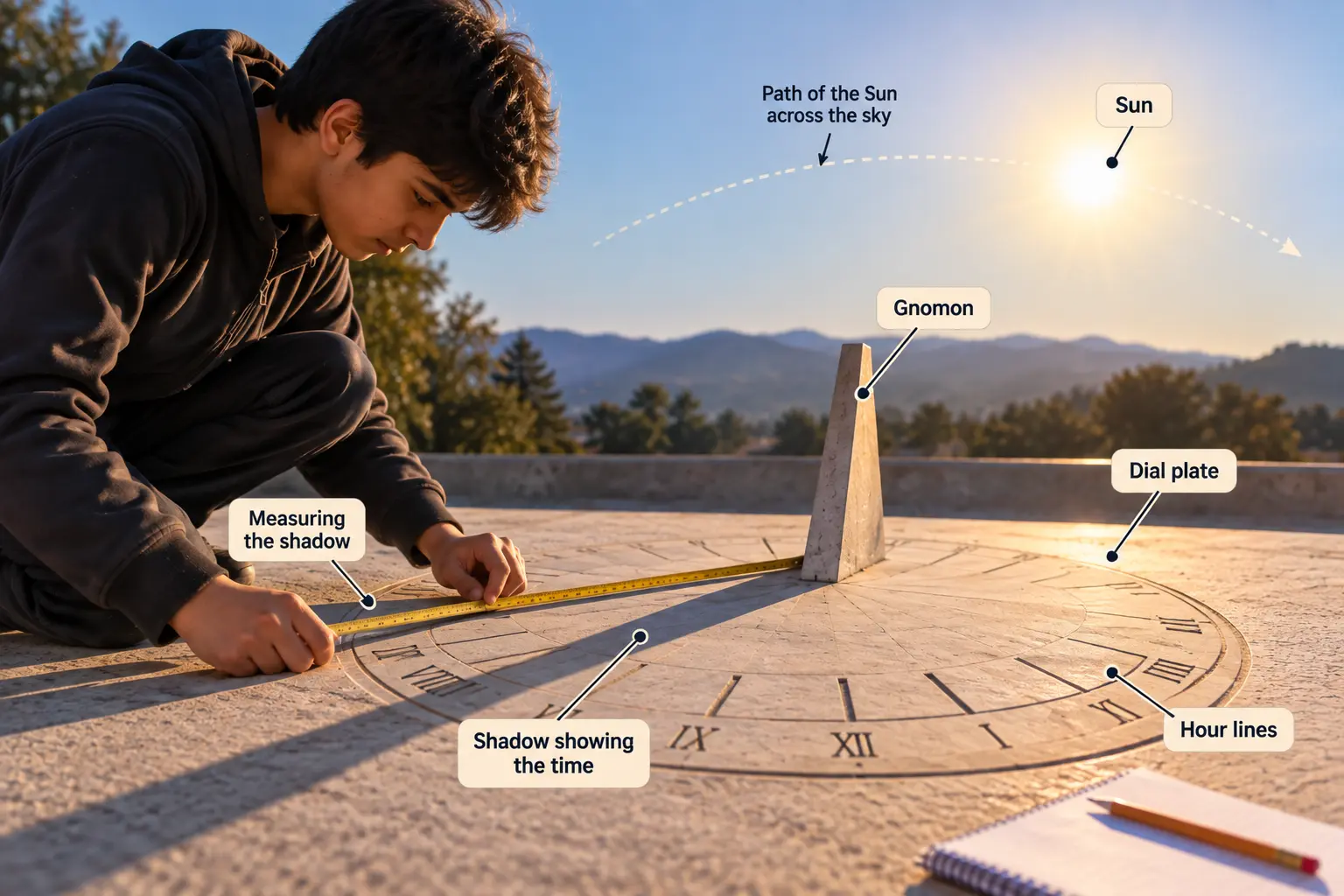
If you are wondering how to make a solstice sundial, constructing a simple gnomon (sundial pointer) is consistently the most effective way to demonstrate planetary mechanics.
When writing practical lab manuals and structuring space lab activities for middle school ICSE students, constructing a simple gnomon (sundial pointer) is consistently the most effective way to demonstrate planetary mechanics.
Instead of just talking about the shortest day of the year, you can prove it physically.
-
The Setup: On December 21, place a straight stick (or a 3D-printed gnomon) perfectly vertical on a flat piece of paper in an unshaded area.
-
The Measurement: At exactly “solar noon” (when the Sun is highest in the sky), mark the tip of the shadow.
-
The Proof: This will be the longest shadow of the year cast by your stick. If you repeat this experiment in six months during the summer solstice, the shadow will be drastically shorter.
Essential STEM Educator Gear
If you are running this experiment in a classroom or an astronomy club, having the right practical kits makes all the difference.
Educational Equatoreal Sundial Kit
Precision Magnetic Compass for Solar Alignment
(Are you building out a full observational curriculum for the new year? See our complete breakdown in the 5 Best Telescopes for Schools in India and start prepping for the The Ultimate 2026 Meteor Shower Calendar).
Frequently Asked Questions (FAQ)
What is the exact december solstice 2026 time?
The December solstice occurs globally on December 21, 2026, at 20:50 UTC. In the United States (EST), this translates to 3:50 PM on December 21.
Is December 21 the Winter Solstice everywhere on Earth?
No. While it is the winter solstice in the Northern Hemisphere, it is the summer solstice in the Southern Hemisphere.
Why are shadows so long on the Winter Solstice?
Because the Northern Hemisphere is tilted 23.5 degrees away from the Sun, the Sun appears very low on the horizon, taking a shallow trajectory that results in elongated shadows.