
December brings the undisputed king of the night sky. While the Perseids get all the summer hype, the Geminid meteor shower 2026 is actually the strongest, most reliable, and most colorful astronomical event of the year.
Fast Facts: Geminid Meteor Shower 2026
-
Peak Date: Night of December 13 into the early morning of December 14, 2026.
-
Expected Rate: Up to 120–150 meteors per hour under dark skies.
-
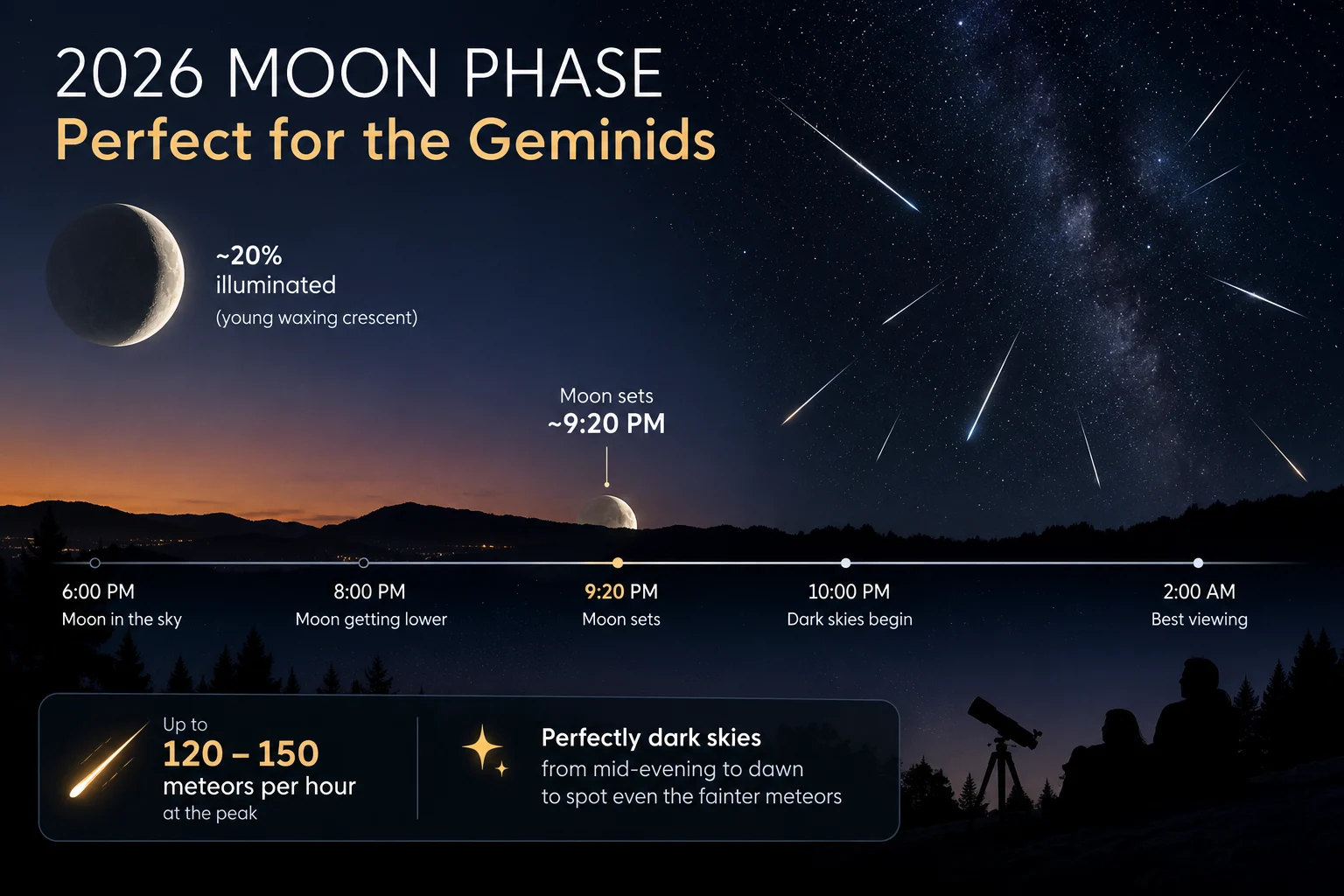
Moon Phase Interference: None. A 23% waxing crescent moon sets around 9:00 PM local time.
-
Parent Body: Asteroid 3200 Phaethon.
If you have ever wanted to introduce your family to stargazing, this is the exact night to do it. Unlike other major showers that require waking up in the freezing pre-dawn hours, the Geminids offer a rare “before midnight” viewing window. In my middle school physics classrooms, where I teach the ICSE curriculum to Grade 6 through 8 students, I always emphasize the Geminid meteor shower 2026 as the ultimate winter observing project because it is accessible, spectacular, and requires zero optical equipment.
Here is everything you need to know about watching the Geminids, why they glow in multiple colors, and how to stay warm under the December sky.
-
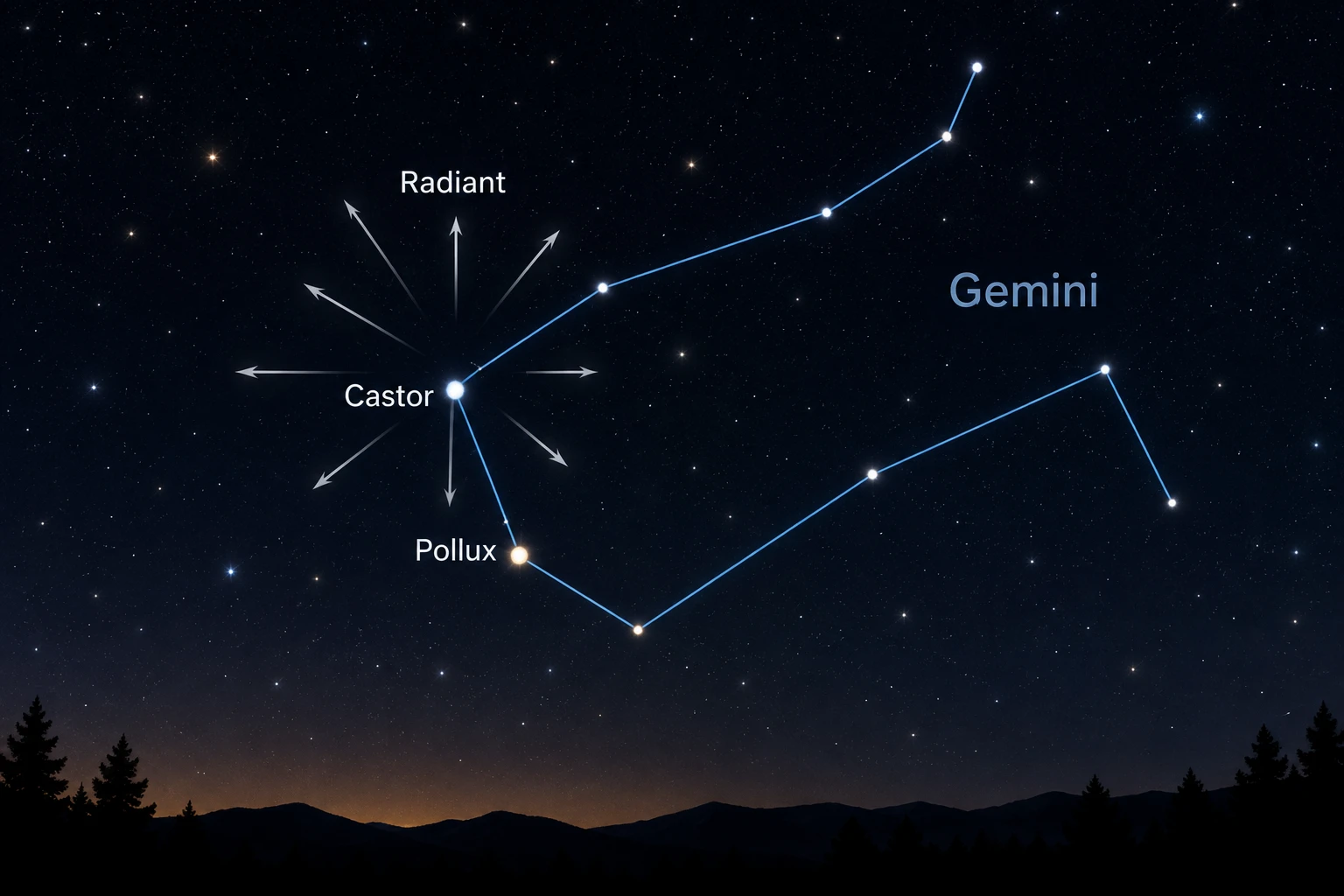
The Geminid meteors radiate from the constellation Gemini the Twins, near the bright stars Castor and Pollux, rising high in the eastern sky by mid-evening.
When to Watch the Geminid Meteor Shower 2026
The Geminids are active from early December, but the shower reaches its absolute peak on the night of December 13 into the early morning of December 14, 2026.
| Time Zone | Date | Peak Viewing Window | Moon Interference |
| New York (EST) | Dec 13 – 14 | 9:00 PM to Dawn | None (Sets ~8:45 PM) |
| London (GMT) | Dec 13 – 14 | 10:00 PM to Dawn | None (Early moonset) |
| Mumbai / New Delhi (IST) | Dec 13 – 14 | 10:00 PM to Dawn | None (Early moonset) |
The “Before Midnight” Advantage
For most meteor showers, the radiant point (where the meteors originate) does not rise until after midnight. The Geminids are the grand exception. The constellation Gemini rises above the eastern horizon by 9:00 PM local time.
By 10:00 PM, the shower is already producing dozens of meteors per hour. This makes the Geminid meteor shower 2026 the absolute best event for parents, students, and working professionals who cannot stay up all night.
The 2026 Moon Phase is Perfect
In 2026, the moon is a very thin waxing crescent (about 15-20% illuminated) that will set by 8:45 PM. This means that from 9:00 PM straight through to dawn, the sky will be perfectly dark, allowing you to catch the fainter shooting stars. Under these ideal conditions, you can expect to see upwards of 120 meteors per hour during the peak.
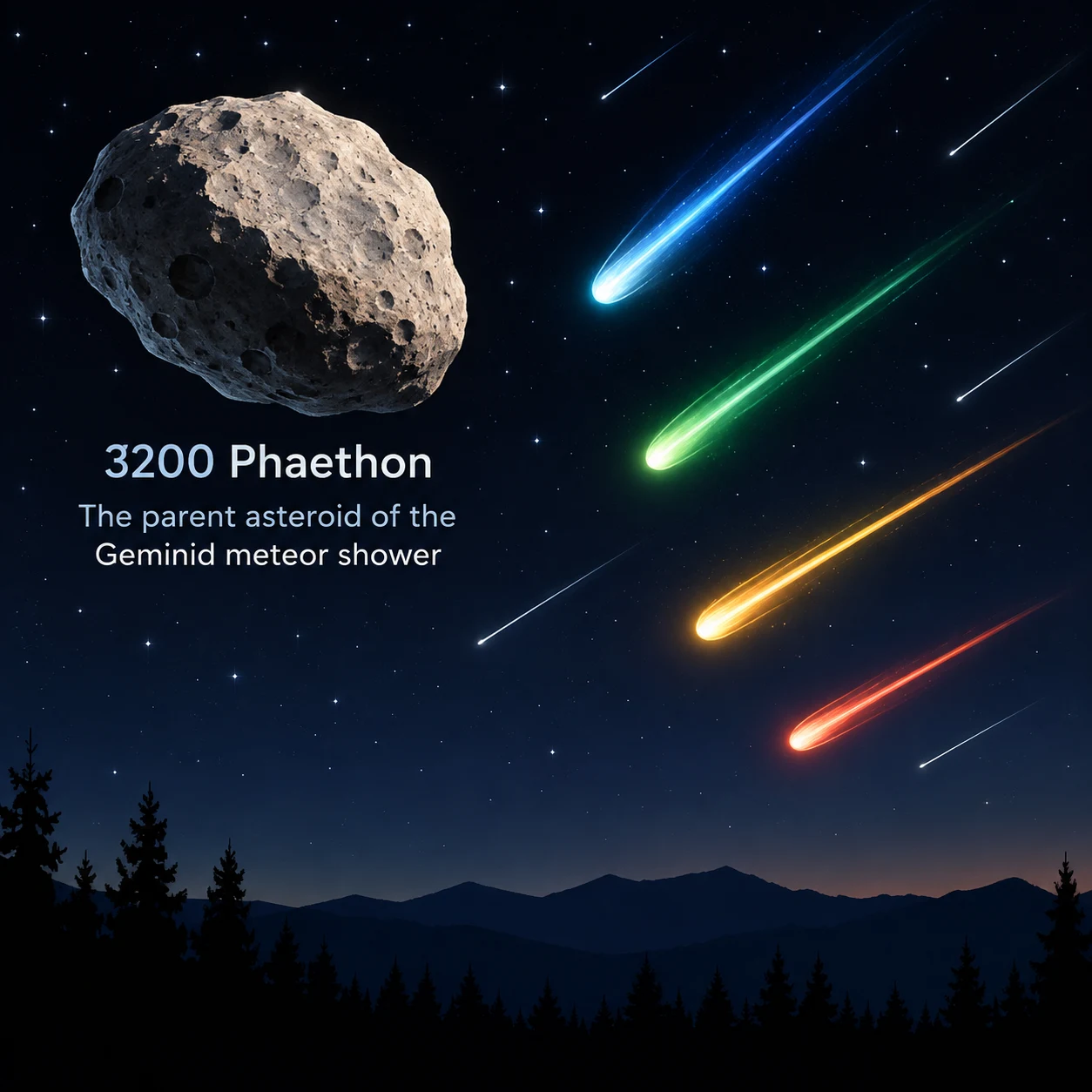
Asteroid 3200 Phaethon: Why Geminids Are Multi-Colored
Almost all meteor showers are created by the icy, dusty debris left behind by comets. The Geminids are uniquely different. They are born from a bizarre rocky body called Asteroid 3200 Phaethon.
Because these meteors are made of denser rock and metal rather than fluffy comet ice, they penetrate much deeper into Earth’s atmosphere before burning up. This dense metallic composition creates something magical: multi-colored meteors.
Because these meteors are made of denser rock and metal, they ionize different elements in the atmosphere, producing vibrant colors rather than standard white streaks:
-
Green Meteors: Burning Nickel
-
Yellow Meteors: Burning Iron
-
Blue Meteors: Burning Magnesium
Essential Gear for December Stargazing
To truly enjoy the Geminid meteor shower 2026, you must prepare for the December cold. A shivering observer will only last 15 minutes outside. Do not bring a telescope (it restricts your view of the sky); instead, invest heavily in your personal thermal comfort.
-
Portable Stargazing Chair: Forget cold canvas camp chairs. A chair will fundamentally change how long you can comfortably observe the night sky. Reclining Camp Chair
-
Heavy-Duty Thermal Beverage Flask: Sipping hot tea or cocoa is essential for family observing sessions to keep everyone’s core temperature elevated. 1-Liter Vacuum Insulated Stainless Steel Thermos
-
Red Light Headlamp: Keep your night vision intact while checking star maps or pouring drinks in the dark. Astronomer’s Red Light Headlamp
(Are you setting up a broader STEM observing program for your school? Be sure to check out our B2B procurement guide on the 5 Best Telescopes for Schools in India.)
Frequently Asked Questions (FAQ)
What makes the Geminid meteor shower 2026 different from the Perseids?
Unlike the Perseids, which originate from an icy comet, the Geminids originate from a rocky asteroid (3200 Phaethon). This allows the Geminids to burn brighter, last longer, and frequently display colors like green, yellow, and blue.
When is the best time to see the Geminids peak date 2026?
The shower peaks on the night of December 13 into the morning of December 14, 2026. Because the moon sets early, the absolute best time to watch is anywhere between 10:00 PM and 2:00 AM local time.
Where should I look to see the Geminid meteor shower 2026?
The meteors radiate from the constellation Gemini in the eastern sky. However, for the best view, do not stare directly at Gemini. Look roughly 45 degrees away from the radiant point to catch the longest, most spectacular multi-colored streaks.
Will the moon ruin the 2026 Geminid meteor shower?
No. In 2026, the moon is a thin waxing crescent that will set early in the evening (before 9:00 PM in most locations), leaving the prime late-night viewing hours perfectly dark.