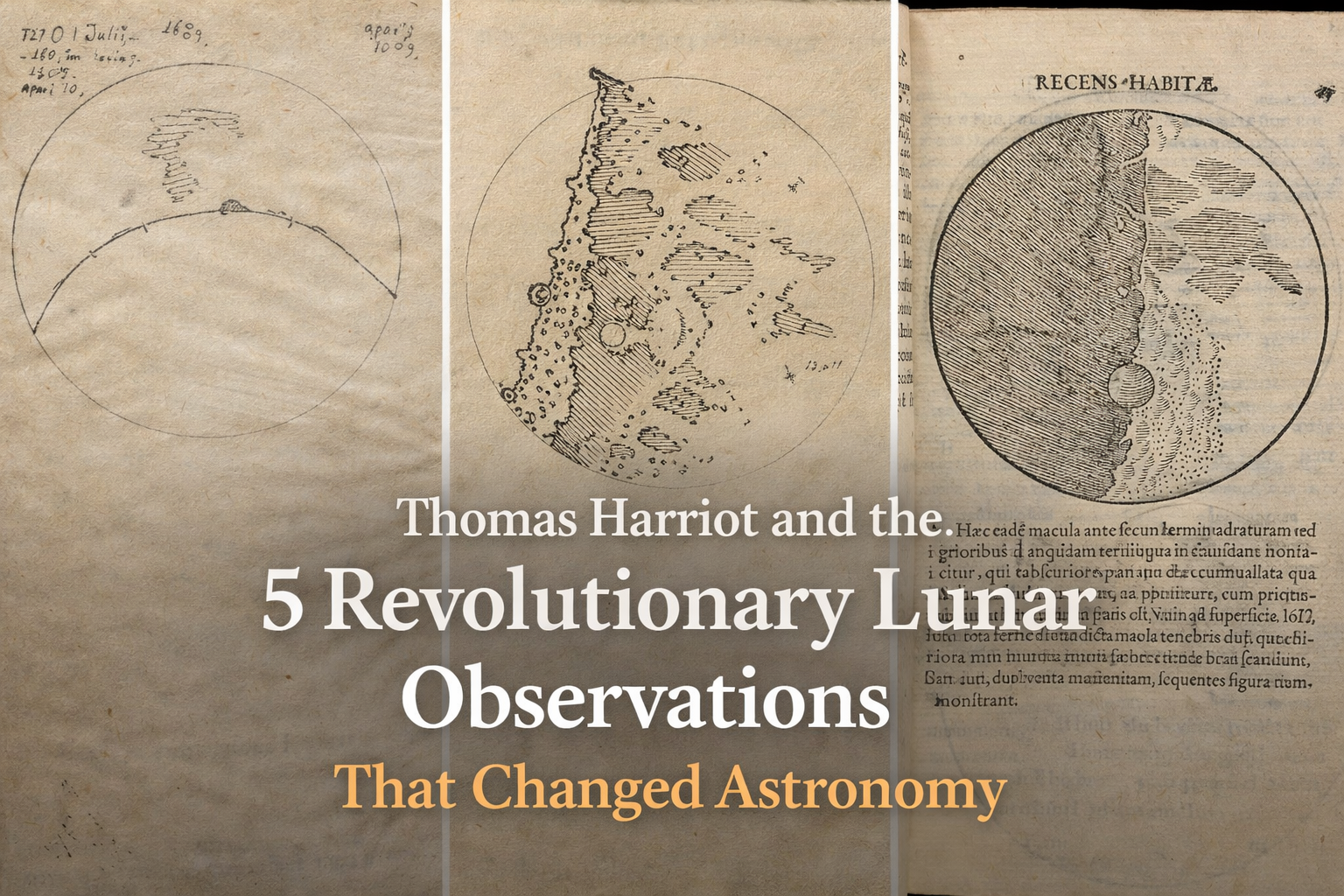
On 26 July 1609, Thomas Harriot, an English mathematician and natural philosopher, achieved a foundational milestone in the history of astronomy by conducting the earliest known telescopic observations of the Moon. Using a modest 6× “Dutch trunk” refracting telescope, Harriot carefully sketched the lunar surface, inaugurating a new era of empirical astronomical research and reshaping humanity’s understanding of the cosmos.
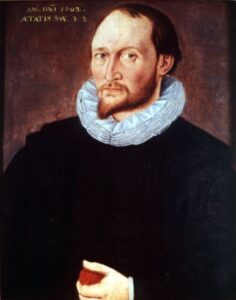
Born in 1560, Harriot was already an accomplished polymath when he turned a telescope skyward. His lunar sketches, produced months before any published work by Galileo, represent the true genesis of telescopic astronomy.
Pioneering the First Telescopic Observation
Before Harriot’s work, telescopes were used almost exclusively for terrestrial and navigational purposes. Harriot’s decision to apply this emerging technology to celestial observation marked a decisive methodological shift. On that July night in 1609, he documented the Moon’s terminator, recording distinct dark regions and surface irregularities—features now identified as lunar maria.
Crucially, Harriot did not merely observe; he rendered. His sketches introduced visual conventions that laid the conceptual foundations of lunar cartography, transforming the Moon from a philosophical abstraction into a mapped physical world.
Before Galileo: Establishing Priority
Harriot’s first lunar observation preceded those of Galileo Galilei, who began systematic telescopic studies of the Moon in November–December 1609. While Galileo’s observations would soon revolutionize European science, Harriot’s detailed records demonstrate that the earliest telescopic engagement with the Moon was English, not Italian, and occurred several months earlier.
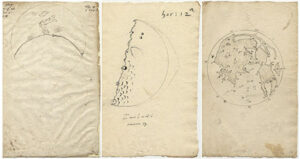
These drawings therefore constitute the earliest surviving evidence of telescopic astronomy.
From First Sketches to the First Moon Maps
Harriot’s engagement with the Moon did not end with his initial sketches. Over the following years, he refined his observational techniques, culminating in two remarkably detailed lunar maps produced in 1612–1613. These maps accurately depicted the relative positions and shapes of lunar features and are widely regarded as the most precise lunar representations of their time, surpassing even Galileo’s early illustrations in cartographic accuracy.
Yet, unlike Galileo, Harriot chose not to publish.
Why Galileo’s Name Endures
The divergence in legacy is largely a matter of dissemination. Galileo rapidly published his findings in Sidereus Nuncius (Venice, 1610), securing immediate recognition and patronage. Harriot, by contrast, circulated his work privately among a small circle of associates. As a result, his pioneering lunar studies remained largely unknown during his lifetime and for centuries thereafter.
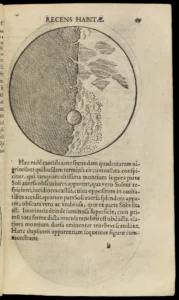
While Galileo’s findings were rapidly disseminated through Sidereus Nuncius, preserved today by institutions such as the Library of Congress, Thomas Harriot’s original lunar drawings remained unpublished. Many of Harriot’s manuscripts are now held by the British Library, providing crucial insight into the earliest phase of telescopic astronomy.
A Polymath Beyond the Moon
Harriot’s scientific contributions extended well beyond astronomy:
- Optics: He independently derived the law of refraction decades before its formal publication.
- Mathematics: He advanced algebraic notation, explored binary numeration, and contributed to spherical geometry.
- Ballistics and Cryptography: His work supported Elizabethan military science and intelligence.
- Cometary Science: His observations of the 1607 comet later enabled its identification as Halley’s Comet, over 170 years afterward.
Legacy and Recognition
Harriot died in London on 1 July 1621, his achievements largely uncelebrated. Only through later historical scholarship has his role been properly acknowledged. Today, historians recognize his first telescopic sketch of the Moon as a turning point that ushered in evidence-based, observational astronomy.
More than four centuries later, Thomas Harriot stands revealed as the unheralded originator of telescopic lunar observation and mapping. His work reminds us that scientific revolutions are not defined solely by publication or fame, but by insight, precision, and the courage to observe the universe in new ways.
Interested in more astronomy stories and explainers? Read our other blogs on observational astronomy, space science, and telescope basics.
Planning your own observations? Check the current Moon phase before heading out with your telescope.