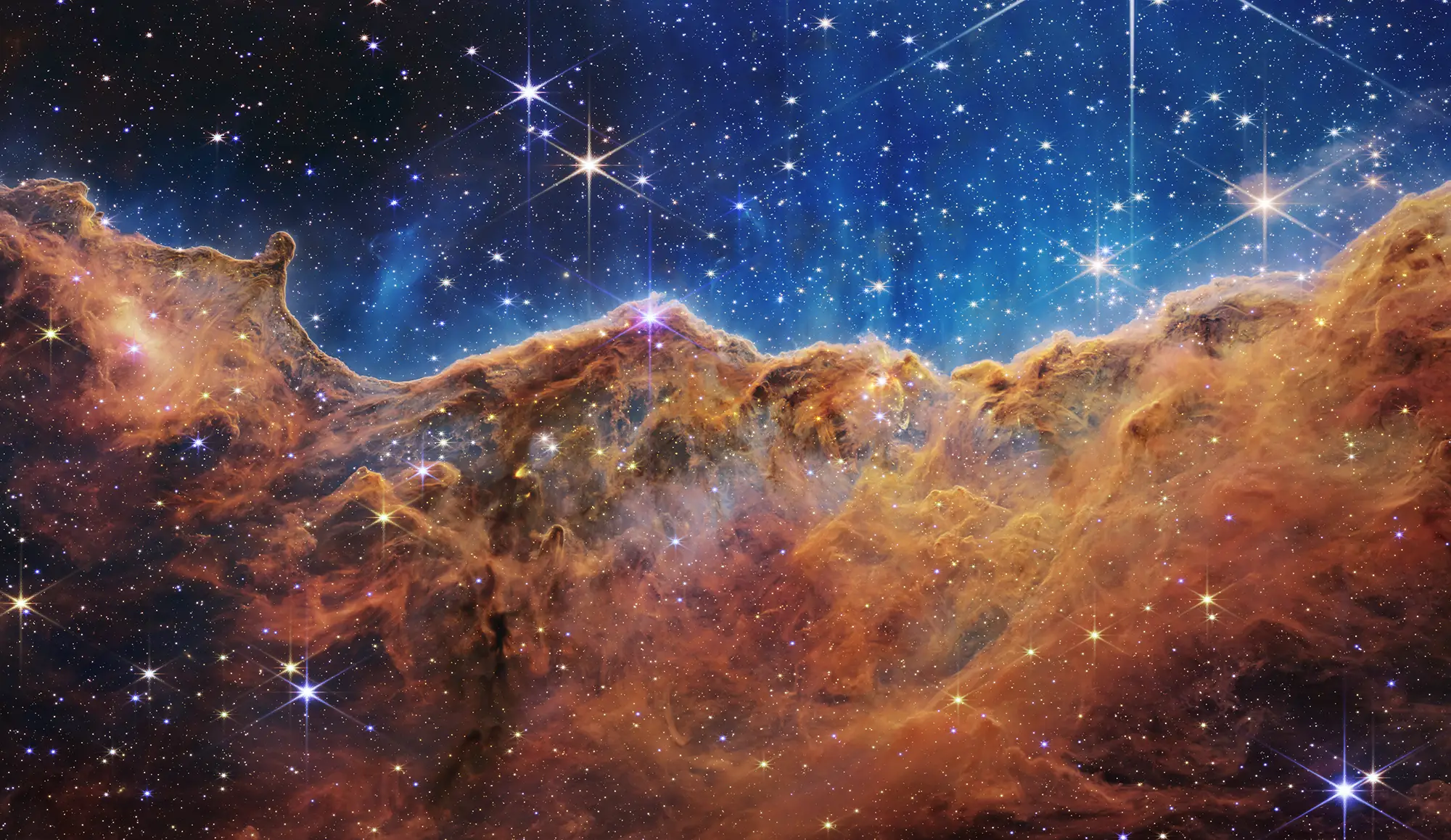
The universe has just revealed two of its deepest secrets—and once again, the James Webb Space Telescope (JWST) is responsible. Astronomers have confirmed the oldest and most distant supernova ever observed, alongside compelling evidence for a long-hypothesized population of “monster stars” that may explain how supermassive black holes formed so early in cosmic history.
Together, these discoveries are transforming our understanding of the universe’s first billion years.
The Most Distant Cosmic Explosion Ever Observed
JWST has detected light from a supernova that exploded when the universe was only ~730 million years old—less than 6% of its current age. This makes it the earliest confirmed stellar explosion ever recorded.
A Gamma-Ray Burst from the Cosmic Dawn
The discovery began with the detection of a Gamma-Ray Burst (GRB)—the most energetic type of explosion known in the universe. GRBs typically occur when a massive star collapses under its own gravity, forming a black hole and releasing a brief but intense flash of gamma radiation.
JWST observations later confirmed that this GRB was indeed associated with a supernova in an extremely distant host galaxy.
Why this matters:
This event provides a new benchmark for studying:
-
Early massive star formation
-
Black hole birth in the young universe
-
The expansion history of the cosmos
Solving a 20-Year Mystery: The “Monster Stars” of the Early Universe
One of modern astrophysics’ biggest puzzles has been understanding how supermassive black holes (SMBHs)—with masses millions to billions of times that of the Sun—formed so quickly after the Big Bang.
JWST may now have provided the missing link.
Chemical Fingerprints in an Ancient Galaxy
In the distant galaxy GS 3073, astronomers detected a highly unusual chemical signature:
an extreme excess of nitrogen relative to oxygen.
This imbalance is exactly what theoretical models predict would be left behind by supermassive primordial stars, also known as monster stars.
What Were Monster Stars?
-
Mass: ~1,000–10,000 times the mass of the Sun
-
Lifetime: Extremely short
-
Fate: Direct collapse into massive black holes (no supernova explosion)
Just before collapsing, these stars would eject nitrogen-rich material—leaving behind the precise chemical imprint JWST has now observed.
In short: these monster stars are likely the long-sought seeds of early supermassive black holes.
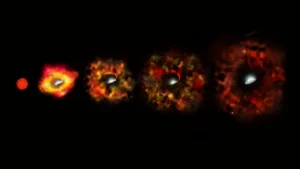
Alt text: Artist’s illustration of a primordial supermassive star collapsing into a black hole
Why These Discoveries Are So Important
These findings are not incremental—they are paradigm-shifting.
Rewriting Cosmic Timelines
They show that:
-
Massive stars formed earlier than expected
-
Black holes grew rapidly in the universe’s infancy
Understanding Our Origins
The chemical elements released by early stars ultimately shaped:
-
Galaxies
-
Planets
-
The conditions necessary for life
JWST’s Transformational Power
These discoveries highlight JWST’s unmatched ability to:
-
See through cosmic dust
-
Probe extreme distances
-
Study the universe’s earliest epochs
What Comes Next?
As JWST continues its mission, astronomers expect more “impossible” discoveries—objects that challenge our assumptions about how fast the universe evolved after the Big Bang.
The cosmic story is only beginning to unfold.
Stay tuned. The universe still has secrets to reveal.